
Bembecinus nanus
(Handlirsch, 1892)
Bembecinus nanus is a small sand wasp in the tribe Stizina, Crabronidae. Like other members of its , it excavates burrows in sandy substrates and provisions nests with leafhoppers (Cicadellidae) for its larvae. The species practices , bringing prey to the developing larva on an as-needed basis rather than . It is one of approximately 190 Bembecinus species worldwide and among ten species recorded from North America north of Mexico.
Pronunciation
How to pronounce Bembecinus nanus: /bɛmˈbɛsɪnəs ˈneɪnəs/
These audio files are automatically generated. While they are not always 100% accurate, they are a good starting point.
Identification
Distinguished from similar sand wasps by the combination of: convergent ventrally and divergent dorsally; or nearly petiolate second submarginal in forewing; small size (8–10 mm); and nesting in sandy substrates. Differs from Bicyrtes by subtribal characters and wing venation. Separated from Microbembex by Stizina tribal affinities. Males may be mistaken for females due to tarsal digging spines, but these structures are shorter than female digging apparatus.
Images
Appearance
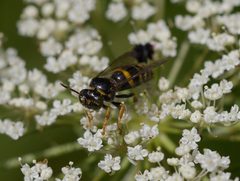
Small , estimated 8–10 mm in length. strongly convergent at bottom of and strongly divergent at top of . Second submarginal in forewing or nearly so. Body form compact, adapted for burrowing in sand. present: males possess short tarsal rakes of spines on front feet, an for digging to reach pre-emergent females.
Habitat
Sandy areas suitable for burrow excavation. Nests constructed in loose sand, often in with multiple females nesting in close proximity. Vegetation nearby provides substrate for sleeping clusters and hunting grounds for leafhopper prey.
Distribution
North America; specifically recorded from the United States including Colorado. Global distribution includes all continents except Antarctica, though B. nanus itself appears restricted to Nearctic region.
Seasonality
Active during summer months, with observations in late July documented. active even on extremely hot days. Males emerge before females and gather in sleeping clusters early in season; female-only clusters occur later.
Diet
hunt leafhoppers (Cicadellidae and related ) as larval provisions. Prey items delivered progressively to developing larvae rather than stockpiled. Recorded prey delivery rates for range from 71 to 757 items per nest, varying with prey size.
Life Cycle
Complete with solitary nesting. Female excavates burrow, lays single in terminal , then provisions progressively with leafhoppers. Larva feeds as food is delivered, eventually entering pre-pupal stage at which point burrow is permanently sealed. Female then initiates new nest. Multiple per season possible given short development time.
Behavior
Females exhibit strong nest fidelity, returning repeatedly to complete burrows despite disturbances. Aggressive defense of nest entrance observed, including physical ejection of intruders such as ants. Gregarious nesting with multiple females in small areas. Both sexes form sleeping clusters on vegetation near nesting sites—males alone early season, females alone late season. Males actively dig for pre-emergent virgin females and engage in intense physical competition for mates, including fighting with already-coupled pairs.
Ecological Role
of leafhoppers, potentially contributing to of these herbivorous insects. Prey for velvet ants (Mutillidae) and cuckoo wasps (Chrysididae) as documented nest . Absence of sarcophagid fly distinguishes it from most other burrowing .
Human Relevance
Minimal direct economic impact. Presence indicates healthy sandy . May contribute to of leafhopper pests in agricultural areas adjacent to natural sandy habitats.
Similar Taxa
- Bicyrtes speciesSimilar size and sand-nesting habit, but differ in subtribal placement (Bembicina vs. Stizina) and wing venation details including second submarginal shape.
- Microbembex speciesComparable small size and burrowing , but placed in different subtribe (Bembicina) with distinct morphological characters.
- Other Bembecinus speciesTen occur in North America north of Mexico; precise identification requires examination of detailed morphological characters not fully documented for B. nanus in available sources.
More Details
Parental Care
is relatively advanced among solitary and represents significant maternal investment. The female must make repeated foraging trips while simultaneously maintaining nest defense.
Male Dimorphism
Male digging adaptations (tarsal rakes) represent with females for mate-finding rather than nest construction, a rare example of sexually dimorphic tool use in .
Parasite Resistance
The absence of Sarcophagidae (satellite fly) in Bembecinus, despite these flies being ubiquitous of other burrowing , remains unexplained and warrants investigation.