
Dryudella
Spinola, 1843
Species Guides
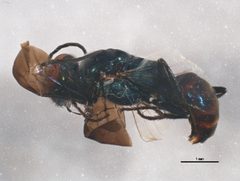
1Dryudella is a of solitary digger wasps in the Crabronidae, Astatinae, containing over 50 described distributed across the Holarctic region. These small (typically under 10 mm) are specialized of true bugs (Hemiptera), with females constructing nest burrows in sandy soils to provision their offspring. Males exhibit distinctive that meet at the top of the and possess broad hind wings that enable rapid from perches on twigs and stems. The genus shows sexual segregation, with females typically in shaded nesting areas and males in sunny locations.
Pronunciation
How to pronounce Dryudella: /dɹaɪʊˈdɛlə/
These audio files are automatically generated. While they are not always 100% accurate, they are a good starting point.
Identification
Males distinguished by that wrap around and meet at the crown of the , and broad hind wings; females have normal separated eyes and unmodified wings. Smaller than the related Astata, with which it shares Astatinae; Astata males lack the often white seen in Dryudella and differ in wing venation. -level identification requires examination of wing venation and other subtle morphological characters.
Images
Habitat
Sandy soils for female nesting; open areas with perches such as twigs and stems for male territories. In North America, primarily associated with arid western ; in Europe, found in sandy, shaded areas for nesting with males in adjacent sunny areas.
Distribution
Holarctic distribution with approximately 29 in the Palearctic and the remainder in the Nearctic. In North America, species are almost entirely restricted to western portions of the continent. Recorded from Europe (including Poland, Ukraine, Denmark, Norway, Sweden), with D. lineata known from only eight countries and considered rare.
Seasonality
active during warmer months. In Poland, D. stigma shows praepupal from mid-July to end of May, with in late spring.
Diet
feed on nectar; larvae are provisioned with paralyzed true bugs (Hemiptera). For D. stigma, adults have been observed visiting Achillea millefolium (Asteraceae) as a primary nectar source.
Life Cycle
Females are , excavating nest burrows 10–12 cm deep with one terminal . Each cell is provisioned with multiple prey items before an is laid. For D. stigma: egg stage 2–3 days, larval stage 11–14 days, praepupal stage overwinters in cocoon from mid-July to end of May.
Behavior
Males perch on twig tips and flower , using their expanded visual field to detect females and rivals, then dart rapidly in pursuit. Females hunt true bugs and transport paralyzed prey beneath the body while flying. Sexual segregation observed: females nest in sandy shaded areas, males occupy sunny territories.
Ecological Role
of heteropteran nymphs including stink bugs (Pentatomidae), coreid bugs, and rhopalid bugs; may contribute to pollination through nectar feeding.
Similar Taxa
Sources and further reading
- BugGuide
- Wikipedia
- GBIF taxonomy match
- iNaturalist taxon
- NCBI Taxonomy
- Catalogue of Life
- Bug Eric: Wasp Wednesday: Dryudella
- Bug Eric: Wasp Wednesday: Astata
- Bug Eric: Wasp Wednesday: The Wasp Tree Part II
- First record of Dryudella lineata Mocsáry, 1879 (Hymenoptera: Crabronidae) on the territory of Ukraine
- Behavioural and ecological data on Dryudella stigma (Panzer, 1809) (Hymenoptera, Astatidae) with the first description of the mature larva
- Figure 1 from: Olszewski P, Bogusch P, Mięsikowski M, Baños-Picón L, Puchałka R (2021) Behavioural and ecological data on Dryudella stigma (Panzer, 1809) (Hymenoptera, Astatidae) with the first description of the mature larva. Journal of Hymenoptera Research 82: 305-316. https://doi.org/10.3897/jhr.82.63594
- Figure 4 from: Olszewski P, Bogusch P, Mięsikowski M, Baños-Picón L, Puchałka R (2021) Behavioural and ecological data on Dryudella stigma (Panzer, 1809) (Hymenoptera, Astatidae) with the first description of the mature larva. Journal of Hymenoptera Research 82: 305-316. https://doi.org/10.3897/jhr.82.63594
- Figure 5 from: Olszewski P, Bogusch P, Mięsikowski M, Baños-Picón L, Puchałka R (2021) Behavioural and ecological data on Dryudella stigma (Panzer, 1809) (Hymenoptera, Astatidae) with the first description of the mature larva. Journal of Hymenoptera Research 82: 305-316. https://doi.org/10.3897/jhr.82.63594
- Figure 3 from: Olszewski P, Bogusch P, Mięsikowski M, Baños-Picón L, Puchałka R (2021) Behavioural and ecological data on Dryudella stigma (Panzer, 1809) (Hymenoptera, Astatidae) with the first description of the mature larva. Journal of Hymenoptera Research 82: 305-316. https://doi.org/10.3897/jhr.82.63594
- Figure 2 from: Olszewski P, Bogusch P, Mięsikowski M, Baños-Picón L, Puchałka R (2021) Behavioural and ecological data on Dryudella stigma (Panzer, 1809) (Hymenoptera, Astatidae) with the first description of the mature larva. Journal of Hymenoptera Research 82: 305-316. https://doi.org/10.3897/jhr.82.63594