
Astatinae
Lepeletier de Saint Fargeau, 1845
Astatina wasps
Genus Guides
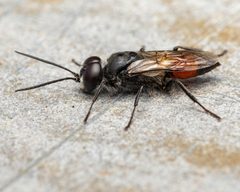
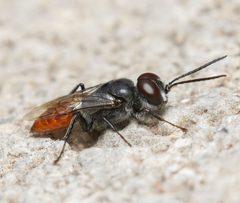
3Astatinae is a of solitary in the Crabronidae, comprising approximately 14 in North America and additional species across Europe and Asia. The subfamily includes two primary : Astata and Dryudella. Males are readily distinguished by their —enormous that meet at the top of the —and exceptionally broad hind wings that enable rapid . Females are , constructing multi-celled nest burrows in soil or sand and provisioning them with paralyzed true bugs (Hemiptera) as food for their larvae.
Pronunciation
How to pronounce Astatinae: /ˌæstəˈtaɪniː/
These audio files are automatically generated. While they are not always 100% accurate, they are a good starting point.
Identification
Males are easily recognized by their meeting at the top of the and broad hind wings—features absent in females. Wing venation differences separate the two : Astata and Dryudella exhibit distinct venation patterns that provide more conclusive identification than size or coloration alone. Males of Dryudella often have white , unlike Astata males. Females of both genera lack the tarsal rake (strong spines on forelegs) found in sand wasps, instead using their legs to pull soil during excavation.
Images
Appearance
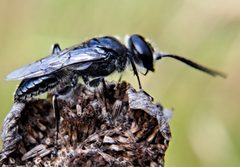
is pronounced. Males possess that broadly meet at the crown of the , providing nearly 360-degree vision. Their hind wings are conspicuously broadened compared to females. Females have normal, separated eyes and unmodified wings. Both sexes are solitary of small to medium size; Dryudella are typically under 10 mm, while Astata species are generally larger. Coloration varies by species, with some males exhibiting bi-colored patterns.
Habitat
Arid and semi-arid environments predominate in North American ranges, including open fields, desert margins, and residential areas with exposed soil. Western North America represents the primary distribution for U.S. and Canadian . Turkish occupy valley systems with suitable nesting substrates. Nesting requires accessible sand or soil for burrow excavation.
Distribution
distribution with strong representation in North America (14 north of Mexico, primarily western), Europe, and Asia. Kelkit Valley, Türkiye records include 10 species and one of Astata and two species and one subspecies of Dryudella. North American records span the Sonoran Desert and adjacent regions.
Seasonality
activity peaks during late morning and early afternoon hours in desert regions. Seasonal distribution data from Türkiye (2013-2018 collections) documented, though specific periods vary by and latitude.
Host Associations
- Pentatomidae - preyAstata females provision nests with nymphs; multiple accumulated per
- Harmostes - preyScentless plant bug recorded as prey for Dryudella
- Hemiptera - prey collectively preys on true bugs; Dryudella records include assassin bugs, negro bugs, shield bugs, seed bugs, burrower bugs, broad-headed bugs, and scentless plant bugs ( and nymphs)
Life Cycle
Females are solitary nesters, each excavating individual burrows in sand or soil without tarsal rakes, instead pulling soil from holes. Nests are multi-celled tunnels partitioned with mud curtains into several chambers in at least some . Multiple prey items are accumulated per before the female prepares the next chamber. Larval development occurs within provisioned cells underground.
Behavior
Males perch at tips of twigs, dried flower , or occasionally on ground surfaces and small stones, maintaining elevated or exposed positions. They are extraordinarily alert to motion, launching into extremely rapid —seeming to vanish instantly—when disturbed or when pursuing targets. They may return to the same perch or relocate to nearby perches. Whether this perching functions in mate location remains unknown, though it resembles landmark mating systems of other insects. Females are exclusively focused on nesting and provisioning activities during peak activity hours.
Ecological Role
of Hemiptera, potentially contributing to of true bugs in arid . Their nesting activity may influence soil structure and aeration in localized areas.
Human Relevance
No documented negative impacts. Occasional observations in residential gardens and settings. Not known to sting humans aggressively; stinging apparatus present but used primarily for prey subduing.
Similar Taxa
- other Crabronidae subfamilies (e.g., Bembicinae)Sand wasps possess tarsal rakes on forelegs for excavation, unlike Astatinae females which pull soil directly
- Dryudella (within Astatinae)Smaller size, males often with white , and distinct wing venation separate from Astata; conclusive identification requires venation examination
More Details
Systematic note
Formerly treated as or as part of Sphecidae; currently classified in Crabronidae following phylogenetic revisions. Authorship dates to Lepeletier de Saint Fargeau, 1845.
Research gaps
Nesting is incompletely known; elaborate multi-celled nest architecture documented in some Astata but may vary across the . Male perching function (mate search vs. territoriality) remains unconfirmed.