
Dryudella caerulea
(Cresson, 1881)
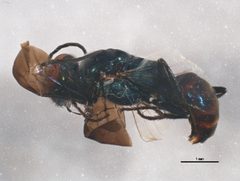
Dryudella caerulea is a solitary in the Crabronidae, Astatinae. It is one of approximately ten North American in the Dryudella. Females are , excavating nest burrows in soil, and provision nests with paralyzed true bugs (Hemiptera) as food for their larvae. The species is found in arid of western North America and Central America. Males possess that meet at the top of the and broader hind wings than females, adaptations associated with their rapid, darting while perching on vegetation to detect mates and rivals.
Pronunciation
How to pronounce Dryudella caerulea: /draɪjuːˈdɛlə səˈruːliə/
These audio files are automatically generated. While they are not always 100% accurate, they are a good starting point.
Identification
Males distinguished from females by and broader hind wings. The Dryudella can be separated from the closely related genus Astata by differences in wing venation; Dryudella are generally smaller than Astata species. Males of Dryudella lack the white often present in male Astata. Within the Astatinae, Dryudella is less specialized in prey selection than other genera. Species-level identification requires examination of detailed morphological characters not described in available sources.
Images
Appearance
Small , likely under 10 mm in length based on congeneric observations. Males have that wrap around and meet dorsally on the , a distinctive . Males also possess broader hind wings than females. The specific epithet 'caerulea' (Latin for 'blue') suggests blue coloration, possibly of the eyes or body. Females have separated eyes and normal wing proportions. Body form typical of Astatinae: compact, with features adapted for digging and prey transport.
Habitat
Arid and semi-arid in western portions of North America. Observed in residential areas in Tucson, Arizona, including flowerbeds and areas with Desert Marigold (Baileya multiradiata). Frequents open, dry environments with exposed soil suitable for nest excavation.
Distribution
North America and Central America. In the United States and Canada, restricted almost completely to western portions of the continent. Specific records from Arizona. Distribution in Central America includes Middle America region.
Seasonality
Active in spring; observed in Tucson, Arizona on May 8, 2010. Seasonal activity likely coincides with availability of prey and suitable nesting conditions in arid environments.
Diet
feed on nectar. Females hunt true bugs (Hemiptera) as larval provisions. Prey includes scentless plant bugs ( Harmostes), assassin bugs, negro bugs, stink bugs, shield bugs, seed bugs, burrower bugs, and broad-headed bugs. Both adult and nymph stages of prey are used. Less specialized in prey selection than other Astatinae genera.
Host Associations
- Harmostes - preyscentless plant bug, observed as prey carried by female
Life Cycle
Solitary nesting. Females excavate burrows in soil, creating multi-celled tunnels partitioned with mud curtains. Each is provisioned with multiple paralyzed true bugs. A single is laid on one prey item. Larva consumes cached prey and pupates within the cell. Developmental timing not documented for this specifically.
Behavior
Females are , digging nest burrows by pulling soil from holes rather than possessing specialized digging spines. When hunting, females carry paralyzed prey beneath the body, which can impede and cause unsteady, wobbling flight. Males perch on twig tips and branches, using and rapid darting flight to detect females and rival males. Males may return to same perch or nearby perches after investigative flights.
Ecological Role
of true bugs (Hemiptera), potentially contributing to of these insects in arid . As a solitary , it serves as prey for various and predators, though specific interactions not documented for this .
Human Relevance
Minimal direct human relevance. Not known to be aggressive toward humans. Occurs in residential areas, suggesting of some anthropogenic disturbance. May contribute to of plant-feeding in gardens and agricultural settings, though this has not been quantified.
Similar Taxa
More Details
Taxonomic Note
Wikipedia lists as , but this is outdated; current classification places Astatinae as of Crabronidae per GBIF and Catalogue of Life.
Male Perching Behavior
Males use elevated perches for landmark-based mate location, a convergent with other insect mating systems. The extraordinary visual field provided by supports detection of small, fast-moving targets.