
Leucospis affinis
Say, 1824
Species Guides
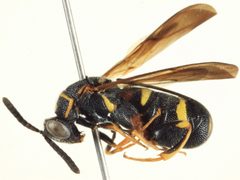
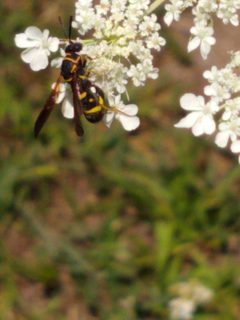
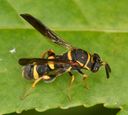
2Leucospis affinis is a large chalcidoid and the most common and widespread North American in the Leucospidae. Females are easily recognized by their whip-like ovipositor that curls over the surface of the , which they use to drill through wood and deposit in the nests of solitary bees. The species is an external (ectoparasitoid) primarily of megachilid bees including leafcutter bees (Megachile), mason bees (Osmia), and resin bees (Dianthidium), though it has also been recorded from the mason wasp Ancistrocerus antilope.
Pronunciation
How to pronounce Leucospis affinis: //luːˈkɒspɪs əˈfɪnɪs//
These audio files are automatically generated. While they are not always 100% accurate, they are a good starting point.
Identification
Most easily confused with mason wasps (Vespidae: Eumeninae) or potter wasps due to similar size, coloration, and wing-folding posture. Distinguished from these by the swollen, toothed hind characteristic of Leucospidae. Females are unmistakable due to the unique dorsally-curved ovipositor; no other North American chalcidoid exhibits this . Males lack the ovipositor and are smaller, requiring careful examination of hind leg structure for confirmation. The six North American Leucospis are difficult to separate without detailed examination.
Images
Appearance
Large for a chalcidoid (3-14 mm), with black and yellow markings resembling mason or potter wasps. Front wings fold longitudinally when not in use. Hind are greatly swollen and toothed, a diagnostic feature of the . Females possess a slender, whip-like ovipositor that arches up and over the back of the ; males are smaller and lack this structure entirely.
Habitat
Associated with containing nesting sites of bees: areas with dead wood, hollow twigs, pre-existing cavities in wood, and artificial substrates such as cardboard tubes or drilled wooden blocks used in operations. Often observed on flowers, particularly wild carrot (Daucus carota), where feed on nectar.
Distribution
North America; recorded from Canada (Alberta, British Columbia, Manitoba) and throughout the United States. The most widespread and frequently encountered Leucospis on the continent.
Seasonality
active primarily in late spring through summer, coinciding with the nesting period of bees. Multiple per year are possible given the rapid development time (approximately 7-12 days for larval feeding, 5 days , 9-14 days to adult ), with late-season individuals potentially as pupae.
Diet
feed on nectar from flowers. Larvae are obligate ectoparasitoids of solitary larvae, feeding externally while attached to the .
Host Associations
- Megachile - primary leafcutter bees
- Osmia - primary mason bees
- Dianthidium - primary resin bees
- Ancistrocerus antilope - secondary mason wasp
Life Cycle
Females locate nests by tapping and drumming against wood surfaces to detect occupied . They drill through wood, cardboard, or other nest substrates using the ovipositor to reach host larvae. are deposited inside host cells; upon hatching, the first larva seeks and destroys any competing leucospid eggs or larvae in the same cell. The surviving larva attaches externally to the host larva and feeds as an ectoparasitoid, consuming the host over 7-12 days. The bee larva typically spins a cocoon before dying, which the leucospid larva then uses for its own . Pupation lasts approximately 5 days, with following in 9-14 days. Late-season individuals may overwinter as pupae within host cocoons. Adult body size correlates with host larva size.
Behavior
Females exhibit distinctive -location : moving back and forth across potential nest substrates while tapping with and drumming with the to detect vibrations or chemical cues indicating host presence. When a suitable host is located, the female unsheathes her ovipositor, arches it over her back, and drills into the substrate while balanced on . Multiple host nests are parasitized by a single female. are known to visit flowers for nectar. The dense typical of chalcidoids is present but less extreme than in cuckoo wasps (Chrysididae).
Ecological Role
A significant of native solitary bees, particularly common and widespread megachilid . of this may influence local abundance of leafcutter and mason bees, though quantitative impact remains understudied. Serves as a food source for . Part of the complex of cavity-nesting Hymenoptera that reuse and partition abandoned wood-boring nests.
Human Relevance
Occasional pest in managed operations, where high densities of artificial nesting substrates can attract numerous . Some mason bee enthusiasts use physical barriers (netting) or nest design (deep drilling, central holes beyond ovipositor reach) to reduce . Otherwise not directly economically significant. Provides educational value in demonstrating and the interconnectedness of cavity-nesting insect .
Similar Taxa
- LeucospisOther five North American in are morphologically similar; separation requires detailed examination of specific characters not covered in general sources.
- Eumeninae (mason wasps)Similar size, black and yellow coloration, and longitudinal wing-folding; distinguished by lack of swollen hind and normal () ovipositor position in females.
- Chrysididae (cuckoo wasps)Similar parasitic lifestyle and metallic coloration in some ; distinguished by highly sculptured, nearly spherical body form and ability to roll into defensive ball.
More Details
Ovipositor mechanics
The dorsally-directed ovipositor of Leucospis affinis is anatomically unusual among Hymenoptera. The female must split open the abdominal segments to deploy this structure, a process that can be repeated multiple times as she parasitizes successive nests.
Parasitoid strategy
The larval of eliminating competitors within the represents a form of contest competition; the first-hatched larva actively seeks and destroys rival or larvae, ensuring sole access to host resources.
Nest substrate limitations
The finite length of the ovipositor restricts to outermost of tubular nests or peripheral regions of wooden galleries; central or deeply placed larvae remain beyond reach, providing a for host .