
Leucospis
Fabricius, 1775
Species Guides
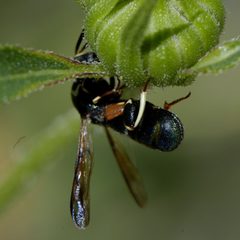
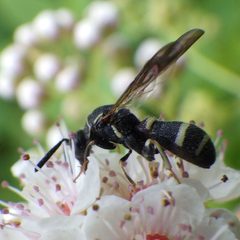
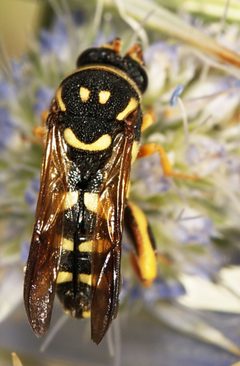
4Leucospis is a of large chalcidoid wasps in the Leucospidae. are typically 2–14 mm long with distinctive yellow and black coloration that resembles mason wasps. Females possess a uniquely curved ovipositor that arches over the back, used to drill into wood and reach larvae in sealed . Larvae develop as on solitary bees and , with typically only one emerging per host cell. The genus has a global distribution in tropical and temperate regions.
Pronunciation
How to pronounce Leucospis: /ˈlu.kɔs.pis/
These audio files are automatically generated. While they are not always 100% accurate, they are a good starting point.
Identification
Distinguished from other chalcidoid wasps by large size (3–14 mm), robust build, and yellow-and-black patterning that mimics vespid . Key diagnostic features include greatly enlarged hind with toothed lower margins, and wings folded longitudinally when at rest. Females have a long, slender ovipositor curved over the ; males are smaller and lack this structure. These traits separate Leucospis from similar-looking mason wasps ( Vespidae, Eumeninae) and from smaller, more typical chalcids.
Images
Habitat
Associated with dry and containing nesting sites of solitary bees and . Found in areas with dead wood, hollow twigs, and pre-existing cavities used by . In human-modified environments, occurs around wooden structures, hotels, and galleried firewood that provide nest sites for mason bees and related hosts.
Distribution
Found worldwide in tropical regions; also present in temperate North America. Documented from North America (including Florida), Brazil (São Paulo state, Jataí Ecological Station), and Sri Lanka. Six occur in North America, with Leucospis affinis being the most common and widespread.
Seasonality
active during spring and summer, coinciding with nesting activity of bees and . Timing varies with host ; in temperate regions, activity peaks when mason bees and leafcutter bees are provisioning nests.
Diet
have been observed feeding on nectar from flowers such as wild carrot (Daucus carota). Larvae are obligate of developing larvae of solitary bees and .
Host Associations
- Megachile - leafcutter bees, primary for Leucospis affinis
- Osmia - mason bees
- Dianthidium - resin bees
- Centris (Heterocentris) analis - documented for Leucospis cayennensis
- Xylocopa virginica - indirect association nests used by subsequent
- Monobia quadridens - indirect associationmason wasp nests in same
Life Cycle
Females locate nests by tapping and drumming against wood surfaces to detect occupied . They drill through wood, cardboard, or other nest materials with the ovipositor to deposit directly into host cells. Eggs hatch in a few days; the first larva to hatch seeks and destroys competing eggs or larvae in the same cell. The surviving larva attaches externally to the host larva and feeds as an , consuming the host over 7–12 days. The host larva typically spins a cocoon before dying; the pupates within this cocoon. occurs 9–14 days after , or the pupa may overwinter. Development time and adult size vary with host size.
Behavior
Females exhibit distinctive -location : moving across nest surfaces while tapping and drumming the against the substrate. They have been observed repeatedly inserting and withdrawing the ovipositor to oviposit in multiple host nests. When not searching for hosts, visit flowers for nectar.
Ecological Role
of solitary bees and , potentially influencing of native including mason bees, leafcutter bees, and resin bees. Part of the natural enemy complex associated with cavity-nesting Hymenoptera.
Human Relevance
Occasionally encountered by beekeepers and enthusiasts, where they may parasitize managed . Some mason bee hobbyists use nest designs with deep galleries or protective netting to reduce . Otherwise has minimal direct interaction with humans; not known to sting or cause structural damage.
Similar Taxa
- MicrapionVery closely related South African ; phylogenetic studies suggest the two genera may be merged
- Eumeninae (mason and potter wasps)Similar yellow-and-black coloration, size, and wing-folding ; distinguished by lack of enlarged toothed hind and different ovipositor structure
- Chrysididae (cuckoo wasps)Share parasitic lifestyle and frequent similar ; distinguished by metallic coloration, compact body form, and different strategy (cleptoparasitism vs. ectoparasitism)
Sources and further reading
- BugGuide
- Wikipedia
- GBIF taxonomy match
- iNaturalist taxon
- NCBI Taxonomy
- Catalogue of Life
- Bug Eric: Wasp Wednesday: Leucospis
- Mason bees in peril when parasitic wasps arrive – Leucospid wasp, Leucospis affinis — Bug of the Week
- Bug Eric: The Wasp Wall
- First record of Leucospis signifera Bouček, 1974 (Insecta: Hymenoptera: Leucospidae) in the São Paulo state, Brazil