
Dianthidium
Cockerell, 1900
Pebble bees, resin bees
Species Guides
6- Dianthidium arizonicum(Arizona Pebble Bee)
- Dianthidium curvatum(Curved Pebble Bee)
- Dianthidium floridiense(Florida Pebble Bee)
- Dianthidium pudicum(Modest Pebble Bee)
- Dianthidium simile(Northeastern Pebble Bee)
- Dianthidium texanum(Texas Pebble Bee)
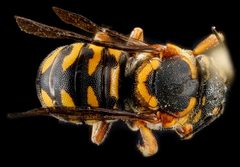
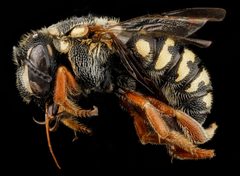
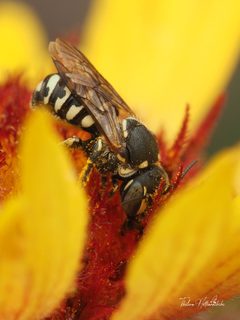
Dianthidium is a of solitary bees in the Megachilidae, commonly known as pebble bees or resin bees. The genus comprises at least 20 described in North America. These bees are distinguished by their use of plant resins in nest construction, gathering resins from various plant sources to build and seal their nest . They are cavity-nesting bees that utilize pre-existing hollows such as borings in dead wood or hollow twigs. Dianthidium species are important and serve as for parasitic in the family Leucospidae.
Pronunciation
How to pronounce Dianthidium: //ˌdaɪænˈθɪdiəm//
These audio files are automatically generated. While they are not always 100% accurate, they are a good starting point.
Identification
Dianthidium bees can be recognized by their robust, often compact body form and their distinctive nesting involving resin collection. They possess scopae (pollen-collecting hairs) on the underside of the rather than on the legs, characteristic of Megachilidae. Many have black and yellow or black and white markings. The can be distinguished from related megachilid genera by their specialized resin-gathering behavior and the use of resin plugs to seal nest . Identification to species level requires examination of morphological details including facial markings, punctation patterns, and genitalia.
Images
Habitat
Dianthidium inhabit a variety of environments across North America, from arid southwestern regions to more temperate areas. They are associated with providing suitable nesting substrates—typically areas with dead wood, hollow twigs, or other pre-existing cavities. The has been recorded from pinyon-juniper woodlands, shortgrass prairie, sand dune habitats, and riparian corridors. Floral resources in the vicinity of nesting sites are essential, with observations from Utah, Arizona, Colorado, Oklahoma, and New Mexico documenting activity in diverse plant .
Distribution
The Dianthidium is distributed across North America, with records from the United States including Vermont and extensive documentation from southwestern states. Specific observations include: San Juan County, Utah (pinyon-juniper woodland); Coconino County, Arizona; various localities in Colorado; northwestern Oklahoma; and northern New Mexico. The genus appears most diverse and abundant in western and southwestern regions of the United States.
Seasonality
Activity patterns vary by and locality. Observations from June and July in southwestern U.S. localities indicate peak activity during summer months. One species, Dianthidium ulkei, has been documented with nest-building and reproductive active during the growing season. Seasonal timing likely corresponds with availability of floral resources and suitable resin sources for nest construction.
Diet
Dianthidium feed on nectar from flowers. Females collect pollen using abdominal scopae to provision nest for their larvae. Documented floral associations include Heterotheca (showy goldenaster) and various other flowering plants in the Asteraceae . The pollen and nectar mixture forms '' that serves as larval food.
Host Associations
- Leucospis affinis - Primary of megachilid bees including Dianthidium; female leucospids lay in nests and larvae develop as on larvae
Life Cycle
Dianthidium has a typical solitary with complete . Females construct nests in pre-existing cavities, creating a series of separated by resin partitions. Each cell is provisioned with a pollen-nectar loaf, an is laid, and the cell is sealed with resin. The final cell is often left empty with a resin plug at the entrance, potentially serving as a decoy for . Larvae develop within cells, pupate, and emerge as . Development time from egg to adult is approximately 3-5 weeks under favorable conditions, with some potentially producing multiple per year or as .
Behavior
The defining of Dianthidium is resin-gathering for nest construction. Females actively collect plant resins from various sources and transport them to nest sites. They use resins to create partitions between and to seal nest entrances. This resin-gathering behavior distinguishes Dianthidium from related such as Osmia (mason bees using mud) and Megachile (leafcutter bees using leaf pieces). Females demonstrate nest site fidelity, returning to the same blocks or natural cavities repeatedly. They may be territorial around active nests.
Ecological Role
Dianthidium function as of diverse flowering plants, contributing to functioning and plant . Their specialized resin-gathering makes them important participants in nutrient cycling and resin resource utilization. As for parasitic including Leucospis, they support higher . Their cavity-nesting habits contribute to wood decomposition processes and create for other organisms in dead wood ecosystems.
Human Relevance
Dianthidium are beneficial in both natural and agricultural settings. They are frequently documented in ' blocks' or 'bee condos'—artificial nesting structures used by gardeners and conservationists to support native bee . Their presence indicates healthy pollinator . The has been studied for its unique resin-gathering , contributing to understanding of bee nesting . Some species may be vulnerable to loss, particularly reduction in dead wood resources and suitable cavity substrates.
Similar Taxa
- OsmiaAlso Megachilidae cavity-nesting bees, but Osmia uses mud or chewed plant material for nest partitions rather than resin; similar body form but different nesting materials
- MegachileLeafcutter bees in same , but cut leaf pieces for nest construction rather than gathering resin; similar abdominal scopae but distinct nesting
- HeriadesRelated resin-using megachilid ; Heriades also uses resin for nest plugs but generally smaller and with different body proportions; both may occur in same blocks
- AnthidiumSame tribe (Anthidiini); Anthidium use plant hairs (wool) or resins depending on species, creating potential identification challenges; Anthidium typically has more extensive yellow or white markings
More Details
Nesting biology
Dianthidium ulkei has been documented constructing nests with resin partitions between and resin plugs sealing the entrance, with one empty cell often left as a potential decoy.
Parasite interactions
Nests in artificial blocks are vulnerable to by sapygid (Sapygidae) and leucospid wasps (Leucospidae), which can locate and exploit concentrated nest .
Resin sources
While specific plant resin sources are not comprehensively documented, Dianthidium gather resins from diverse plants; the requires access to resin-producing vegetation in foraging range of nests.
Sources and further reading
- BugGuide
- GBIF taxonomy match
- iNaturalist taxon
- NCBI Taxonomy
- Catalogue of Life
- Bug Eric: Wasp Wednesday: Leucospis
- Bug Eric: More Drama at the Bee Block
- Eumastacidae | Beetles In The Bush
- Observations on the Nest-building and Reproductive Behavior of a Resin-gathering Bee: Dianthidium ulkei (Hymenoptera: Megachilidae)