
Leucospidae
Walker, 1834
leucospid wasps
Genus Guides
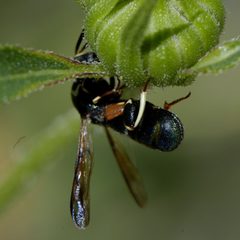
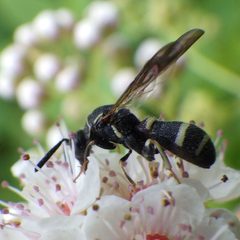
1are a specialized of parasitic within the superfamily Chalcidoidea, distinguished by their relatively large size compared to other chalcidoids. They are ectoparasitoids of solitary bees and wasps, with females laying in nests where larvae attach externally to developing host larvae. The family exhibits distinctive morphological features including enlarged, toothed hind and a uniquely recurved ovipositor that extends dorsally along the in females.
Pronunciation
How to pronounce Leucospidae: //luːˈkɒspɪˌdiː//
These audio files are automatically generated. While they are not always 100% accurate, they are a good starting point.
Identification
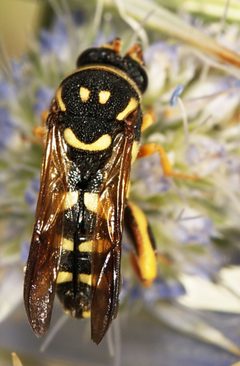
Distinguished from other Chalcidoidea by combination of: greatly enlarged and toothed hind (shared with Chalcididae but with different tooth arrangement); longitudinal wing fold; and uniquely in females, the recurved ovipositor extending dorsally along the metasoma. Males identifiable by the capsule-like fusion of metasomal segments. Often mistaken for mason or potter wasps (Vespidae: Eumeninae) due to similar coloration and size, but distinguished by wing folding and hind leg . Distinguished from Chalcididae by ovipositor position and male abdominal structure.
Images
Habitat
Associated with where solitary bees and nest, including areas with dead wood, hollow twigs, and pre-existing cavities. observed visiting flowers for nectar, particularly composites such as wild carrot. Some associated with dry .
Distribution
Widespread but generally uncommon; approximately 130 in four . Nearly 44 species from the New World, predominantly Neotropical. Documented from North America (including United States), Brazil (São Paulo), Arabian Peninsula (Saudi Arabia, Yemen), Morocco, and Belgium. Fossil species Leucospis glaesaria known from Early Miocene Dominican amber.
Seasonality
active during spring and summer, coinciding with nesting activity. Multiple per year possible with rapid larval development (7–12 days) and (5 days), though late-season individuals may overwinter as pupae.
Host Associations
- Megachilidae - primary leafcutter bees (Megachile), mason bees (Osmia), resin bees (Dianthidium)
- Apidae - including Eulaema meriana
- Sphecidae - solitary
- Chrysididae - hyperparasitoid Leucospis dorsigera parasitizes Xorides sp., which parasitizes cerambycid beetle larvae
Life Cycle
Female deposits inside nests, drilling through wood or nest materials with ovipositor. Larva hatches and immediately seeks and destroys competing leucospid larvae or eggs in same . Survivor attaches externally to host larva as , feeding until host dies. Development rapid: larval stage 7–12 days, 5 days, 9–14 days. Pupation occurs within cocoon spun by host larva. Adult size correlates with host larva size. Usually one adult emerges per host cell, though Leucospis pinna known to produce multiple adults from single cell.
Behavior
Females search for nests by tapping and drumming on nest surfaces to locate host larvae. Ovipositor inserted through wood or nest materials to reach host . visit flowers for nectar. Larvae exhibit lethal , with first-hatched individual eliminating rivals before feeding on host.
Ecological Role
regulating of solitary bees and . Potential impact on native , particularly managed populations. One documented case of hyperparasitism adds complexity to interactions.
Human Relevance
Occasional pest of managed and leafcutter bee used for pollination services. Presence indicates healthy populations of native solitary bees and . Rarely encountered by general observers due to mimicry and relative rarity, though locally abundant where are plentiful.
Similar Taxa
- ChalcididaeShares enlarged, toothed hind , but differs in ovipositor position ( in Chalcididae, recurved in ) and male abdominal structure
- Vespidae (Eumeninae)Similar size, coloration, and longitudinal wing folding, but distinguished by hind leg and parasitic lifestyle
Misconceptions
Often dismissed as 'rare' when in fact frequently overlooked due to effective mimicry of common mason and potter wasps; also commonly misspelled 'Leucospididae'.
More Details
Phylogenetic placement
Traditional morphological studies suggested sister relationship with Chalcididae, but 2011 and 2018 molecular phylogenetic analyses found to be monophyletic with uncertain placement within Chalcidoidea, not closely related to Chalcididae; Oodera (Pteromalidae: Cleonyminae) identified as nearest relative.
Ovipositor mechanism
Female opens dorsally to deploy ovipositor, a unique structural among parasitic that allows drilling through wood and other hard substrates to reach concealed larvae.
Sources and further reading
- BugGuide
- Wikipedia
- GBIF taxonomy match
- iNaturalist taxon
- NCBI Taxonomy
- Catalogue of Life
- Leucospidae | Beetles In The Bush
- Bug Eric: Wasp Wednesday: Leucospis
- Mason bees in peril when parasitic wasps arrive – Leucospid wasp, Leucospis affinis — Bug of the Week
- A chalcidid jewel beetle parasitoid wasp | Beetles In The Bush
- Bug Eric: Wasp Wednesday: The Wasp Tree Part II
- Mason peril - Parasitic wasp, Leucospis affinis — Bug of the Week
- Ethology of the Leucospidae Family (Insecta: Hymenoptera)
- Leucospidae of Morocco with a comparison to the other countries ofNorth Africa
- First record of Leucospis signifera Bouček, 1974 (Insecta: Hymenoptera: Leucospidae) in the São Paulo state, Brazil
- Nouvelles données de Perilampidae, Chalcididae et Leucospidae pour la faune de Belgique (Hymenoptera, Chalcidoidea)
- An overview of the Leucospidae (Hymenoptera, Chalcidoidea) of the Arabian Peninsula with description of a new species