
Ceranisus
Walker, 1841
Species Guides
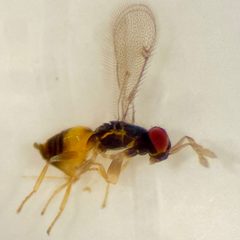
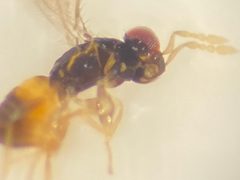
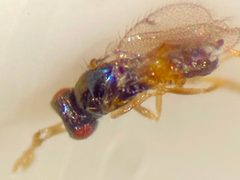
1Ceranisus is a of minute in the Eulophidae. are solitary larval endoparasitoids of thrips (Thysanoptera), with females laying within early larval instars of their . The genus has received attention for its potential in of agricultural thrips pests, including Thrips tabaci, Frankliniella occidentalis, and F. intonsa. Strains collected worldwide show variation in and based on geographic origin and phenotypic appearance.
Pronunciation
How to pronounce Ceranisus: //sɛˈrænɪsəs//
These audio files are automatically generated. While they are not always 100% accurate, they are a good starting point.
Identification
Ceranisus are distinguished from other thrips-attacking Eulophidae by characteristics of the entedonine , including reduced wing venation and specific antennal segmentation patterns. Specific identification to species level requires examination of male genitalia and other microscopic morphological features.
Images
Habitat
Agricultural , particularly crop systems where thrips pests occur; associated with plants of thrips including tomato, grape, and various vegetables and ornamentals.
Distribution
Records from North America (California, Maryland, New York, Ontario), Europe (Canary Islands), and worldwide distribution corresponding to thrips ranges.
Host Associations
- Thrips tabaci - onion thrips, major agricultural pest
- Frankliniella occidentalis - western flower thrips, preferred with higher
- Frankliniella intonsa - slower development and lower compared to F. occidentalis
- Frankliniella schultzei -
- Thrips palmi -
Life Cycle
Solitary larval endoparasitoid development. Females lay within early larval instars of thrips ; larvae develop inside host and kill it. Development is synchronized with host larval development and temperature-dependent. Pupal duration shows marked variation at 20°C and 25°C. Development is faster on western flower thrips than on F. intonsa.
Behavior
acceptance depends on host larval stage, size, and movement. First instar thrips are preferred hosts. As host size increases, fewer are attacked and successfully parasitized. Yellow strains produce more offspring than brown strains but show greater variation in developmental time.
Ecological Role
agent of thrips pests in agricultural systems. Natural enemy that reduces pest ; multiple releases may be needed to control populations of western flower thrips or F. intonsa.
Human Relevance
Used and evaluated as a agent in () systems for thrips control on tomato and other crops. Methyl anthranilate has been identified as an attractant for C. menes and may be useful for monitoring or enhancing activity.
Similar Taxa
- Other Entedoninae generaSimilar reduced wing venation and antennal structure; distinguished by specific male genitalia and microscopic morphological features
More Details
Strain variation
Strains of Ceranisus menes collected worldwide differ in and based on phenotypic appearance (yellow vs. brown color forms) and geographical origin. Yellow strains are more effective agents, producing more offspring than brown strains.
Reproductive capacity
varies by : approximately 2.5 times higher on western flower thrips than on F. intonsa. Average production approximately 80 eggs per female under laboratory conditions.
Taxonomic revision
The was revised in 2005 (Triapitsyn, S.V. 2005. Revision of Ceranisus and the related thrips-attacking entedonine genera of the world. African 46: 261-315) and again for the New World (Triapitsyn, S.V. & J.G. Morse. 2005. A review of the species of Ceranisus in the New World. Transactions of the American Entomological Society 131: 69-86).
Sources and further reading
- BugGuide
- Wikipedia
- GBIF taxonomy match
- iNaturalist taxon
- NCBI Taxonomy
- Catalogue of Life
- Publications | Entomology Research Museum
- Biological control of Thrips tabaci on tomato crop by their parasitoid "Ceranisus menes”
- Ceranisus menes (Hymenoptera: Eulophidae) for Control of Western Flower Thrips: Biology and Behavior
- Host-Parasite Interaction between Frankliniella intonsa, Western Flower Thrips and Ceranisus menes (Hymenoptera: Eulophidae): Development and Reproduction
- Methyl Anthranilate as an Attractant for Two Thrips Species and the Thrips Parasitoid Ceranisus menes
- Development and reproduction of Ceranisus menes (Hymenoptera: Eulophidae), a larval parasitoid of thrips: effects of two host species, Frankliniella intonsa and Thrips palmi (Thysanoptera: Thripidae).