
Acanthochalcis
Cameron, 1884
Species Guides
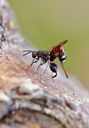
2Acanthochalcis is a of chalcidid wasps in the Chalcididae, Cratocentrinae. These are large, distinctive parasitic characterized by their greatly swollen, toothed hind and exceptionally long ovipositors. The genus contains at least two commonly encountered North American , A. nigricans and A. unispinosa, which are of jewel beetles (Buprestidae), particularly species in the genus Chrysobothris.
Pronunciation
How to pronounce Acanthochalcis: //ˌækænˌθoʊˈkælsɪs//
These audio files are automatically generated. While they are not always 100% accurate, they are a good starting point.
Identification
Members of Acanthochalcis are immediately recognizable among chalcidid wasps by their large size (approximately 19 mm including ovipositor) and extraordinarily long, slender ovipositor. The is distinguished from other chalcidids by the combination of large body size and elongated ovipositor structure. A. nigricans is identified by white pubescent patches on the , which are absent in A. unispinosa.
Images
Habitat
Found in association with dead wood of trees, particularly mesquite (Prosopis glandulosa) and eastern red-cedar (Juniperus virginiana). are observed on or flying around dead branches of host plants.
Distribution
Southwestern United States. A. nigricans occurs from Kansas and Oklahoma west to California. A. unispinosa ranges from Texas to California.
Host Associations
- Chrysobothris octocola - Suspected based on field observations at Gloss Mountains State Park, Oklahoma; observed on dead mesquite branches where C. octocola were abundant
- Chrysobothris femorata - Documented (Universal Chalcidoidea Database)
- Chrysobothris edwardsii - Documented (Universal Chalcidoidea Database)
Behavior
Females are observed searching for on dead wood, using their long ovipositors to probe for woodboring larvae. have been observed in the field on dead branches and flying around host plants.
Ecological Role
of woodboring jewel beetles (Buprestidae). As a member of the Chalcididae, contributes to regulation of buprestid in dead wood .
Similar Taxa
- Acanthochalcis unispinosaSimilar large size and long ovipositor, but lacks white abdominal pubescent patches present in A. nigricans; ranges from Texas to California with overlap in distribution
More Details
Taxonomic notes
Among chalcidid wasps, the large size and very long ovipositor distinguish this from other genera in the .
Research significance
Rearing studies of Acanthochalcis from dead wood batches have potential to reveal new parasitic wasp/ associations, particularly with Chrysobothris jewel beetles.