
Acanthochalcis nigricans
Cameron, 1884
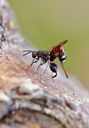
Acanthochalcis nigricans is a large chalcidid distinguished by white pubescent patches on the , which separate it from the similar A. unispinosa. Females possess an exceptionally long ovipositor and measure approximately 19 mm in total length. The is a known of Chrysobothris jewel beetles, including C. femorata and C. edwardsii, and has been observed seeking oviposition sites on dead mesquite branches. It occurs across the southwestern United States from Kansas and Oklahoma west to California.
Pronunciation
How to pronounce Acanthochalcis nigricans: /əˌkænθoʊˈkælˌsɪs ˈnɪɡrɪˌkænz/
These audio files are automatically generated. While they are not always 100% accurate, they are a good starting point.
Identification
Separable from Acanthochalcis unispinosa by presence of white pubescent patches on (absent in A. unispinosa). The combination of large body size, long ovipositor, and abdominal pubescent patches is diagnostic. Within Chalcididae, the Acanthochalcis is distinguished by large size and very long ovipositor relative to other chalcidids.
Images
Appearance
Large chalcidid with greatly swollen and toothed hind characteristic of the . Body predominantly black with distinctive white pubescent patches on the . Female with extraordinarily long ovipositor; total length including ovipositor approximately 19 mm. Hind femora enlarged and armed with teeth. Distinguished from Acanthochalcis unispinosa by presence of abdominal white pubescent patches (absent in A. unispinosa).
Habitat
Associated with dead wood of mesquite (Prosopis glandulosa) and eastern red-cedar (Juniperus virginiana). Found in arid and semi-arid environments including gypsum-capped mesas, sandhills, and desert scrub. Observed in areas with standing dead mesquite branches showing dieback.
Distribution
Southwestern United States: Kansas, Oklahoma, Texas, New Mexico, Arizona, Nevada, California.
Seasonality
active in summer months. Observed in western Texas in late July. Likely associated with activity periods of Chrysobothris beetles.
Host Associations
- Chrysobothris femorata - Known , Universal Chalcidoidea Database
- Chrysobothris edwardsii - Known , Universal Chalcidoidea Database
- Chrysobothris octocola - probable Inferred from field observation on same mesquite branches; not confirmed
- Prosopis glandulosa - Dead branches used for oviposition
- Juniperus virginiana - Dead branches used; associations uncertain
Behavior
Females observed actively searching dead mesquite branches, apparently seeking oviposition sites. suggests location of larvae within dead wood using long ovipositor to penetrate wood and deposit on or near host. Has been observed flying around dead mesquite branches and landing on dead wood surfaces.
Ecological Role
Primary of woodboring jewel beetles (Buprestidae), particularly Chrysobothris . Contributes to of these woodboring beetles in arid . Links dead wood to higher .
Human Relevance
Of interest to entomologists studying - relationships and jewel beetle . Potential agent for pest Chrysobothris , though not documented as commercially used.
Similar Taxa
- Acanthochalcis unispinosaLacks white pubescent patches on ; otherwise similar in size and . Ranges from Texas to California, overlapping with A. nigricans in much of its range.
- Other ChalcididaeDistinguished by large size and exceptionally long ovipositor; most chalcidids are smaller with shorter ovipositors.
More Details
Field encounter notes
First individual encountered was the first insect observed at Gloss Mountains State Park, Oklahoma, on the first day of a collecting trip. Was originally seen on dead mesquite branch, then photographed on eastern red-cedar. All observed that day were associated with dead mesquite branches, suggesting strong fidelity to this substrate.
Taxonomic history
Described by Cameron in 1884. One of only two commonly encountered Acanthochalcis in North America. characterized by large size and very long ovipositor among chalcidids.