
Chrysobothris femorata
(Olivier, 1790)
flatheaded appletree borer
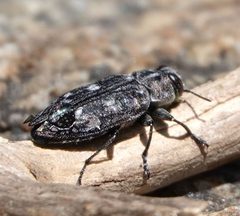
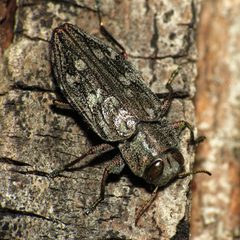
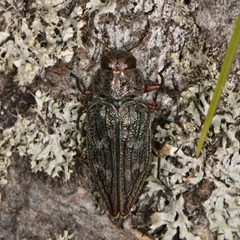
Chrysobothris femorata is a metallic wood-boring beetle in the Buprestidae, commonly known as the flatheaded appletree borer. It is a pest of fruit, shade, and nut trees in North America. The was historically a catch-all for a complex of closely related species, but was taxonomically revised in 2007 to define more precise species limits. are attracted to stressed or dying trees, where females oviposit in bark crevices and larvae tunnel beneath the bark, potentially girdling and killing trees.
Pronunciation
How to pronounce Chrysobothris femorata: //ˌkrɪsoʊˈbɒθrɪs ˌfɛmɔˈreɪtə//
These audio files are automatically generated. While they are not always 100% accurate, they are a good starting point.
Identification
Differs from related in the C. femorata species-group by the combination of: straight posterolateral elytral margins (versus arcuate in C. caddo), reddish elytral apices (versus bronze in C. caddo), shallowly impressed (versus deeply impressed in C. quadriimpressa), and lack of hyaline lateral margin on pygidium (present in C. adelpha). Identification requires examination of multiple character suites; no single diagnostic character reliably separates it from all relatives.
Images
Appearance
are metallic wood-boring beetles with characteristic buprestid body form—elongate, somewhat flattened, and streamlined. The have straight (not curved) posterolateral margins and distinctly reddish tips. Males possess a bright green , while females show reddish tinges behind the and on the . The (terminal abdominal tergite) is shallowly impressed on each side of the middle. Body length approximately 15–18 mm.
Habitat
Associated with deciduous woody plants in landscape, orchard, and forest settings. Most commonly encountered on stressed, dying, or recently windthrown trees. are and found on exposed trunks and logs in sunny conditions.
Distribution
North America, including all continental United States and Canada. More common east of the Continental Divide. Also reported from Central America.
Diet
Larvae feed phloeophagously (on inner bark and cambium) of trees. do not feed on plant material.
Host Associations
- Acer - larval maple
- Betula - larval birch
- Crataegus - larval hawthorn
- Malus - larval apple
- Platanus occidentalis - larval sycamore
- Populus - larval poplar, cottonwood
- Prunus - larval cherry
- Pyrus - larval pear
Life Cycle
Complete . are deposited in bark crevices. Larvae hatch and tunnel beneath the bark, feeding on phloem and cambium. Larvae are flattened in form (giving rise to the
Behavior
are and active on sunny days. Males rapidly search up and down trunks seeking mates. Females probe bark cracks and crevices with their ovipositor to locate -laying sites. Adults are visually oriented, with large adapted for detection. When disturbed, they exhibit rapid, erratic with flash coloration from the brilliant metallic blue-green surface. Attracted to violet and red wavelengths of light, as demonstrated in trapping studies.
Ecological Role
Primary colonizer of stressed and dying deciduous trees. Larval tunneling accelerates tree death by girdling trunks and branches. Contributes to nutrient cycling by initiating wood decomposition. Serves as prey for insectivorous birds and other .
Human Relevance
Significant economic pest of nursery stock, fruit trees (apple, pear, cherry), and landscape shade trees. Larval boring weakens and kills young trees, particularly those stressed by transplanting, sunburn, or other factors. Management in commercial settings relies on protecting tree trunks and monitoring . No reliable monitoring methods existed until recent studies on color-based trapping.
Similar Taxa
- Chrysobothris caddoFormerly confused under C. femorata; distinguished by arcuate (curved) posterolateral elytral margins and bronze (not reddish) elytral apices. Associated primarily with Celtis (hackberry) rather than rosaceous .
- Chrysobothris shawneeFormerly confused under C. femorata; distinguished by larger, bronze-black callosities. Associated primarily with Quercus (oak).
- Chrysobothris quadriimpressaFormerly confused under C. femorata; distinguished by shallowly impressed . Associated primarily with Quercus.
- Chrysobothris maliSimilar (Pacific flatheaded borer) and ; distinguished by geographic distribution (primarily western North America) and molecular/genitalic characters. Recently documented attacking pear fruit, a not previously recorded for the .
Misconceptions
Historically, C. femorata served as a catch-all for multiple cryptic . Many literature records of and distributions actually refer to other species in the complex, particularly records from Quercus and Celtis. The 2007 revision by Wellso and Manley clarified species limits, but specimens in older collections and literature may be misidentified.
More Details
Taxonomic history
The C. femorata -group was last revised by Fisher in 1942. Wellso and Manley (2007) revised the group, describing six new species (C. caddo, C. comanche, C. mescalero, C. seminole, C. shawnee, C. wintu), resurrecting C. quadriimpressa from synonymy, and designating neotypes for C. femorata, C. rugosiceps, and C. viridiceps. The revision doubled the number of described species in the group from six to twelve.
Color vision and trapping
Studies demonstrate attraction to violet-range and red wavelengths. Traps with hues between red and blue (higher b* values) capture more beetles. This visual preference may relate to -location mechanisms, though ecological interpretation remains speculative.
Sources and further reading
- BugGuide
- Wikipedia
- GBIF taxonomy match
- iNaturalist taxon
- NCBI Taxonomy
- Catalogue of Life
- Cindy Kron: Adventures of the North Coast Area Extension Entomologist | Bug Squad
- The Chrysobothris femorata “problem” | Beetles In The Bush
- Introducing Chrysobothris caddo | Beetles In The Bush
- Effects of Color Attributes on Trap Capture Rates ofChrysobothris femorata(Coleoptera: Buprestidae) and Related Species
- A revision of the Chrysobothris femorata (Olivier, 1790) species group from North America, north of Mexico (Coleoptera: Buprestidae)