
Epeolus pusillus
Cresson, 1864
Dwarf Cellophane-cuckoo Bee
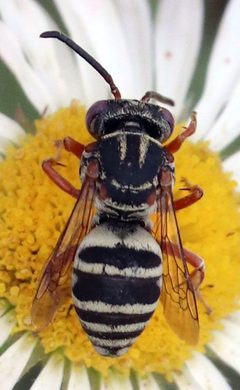
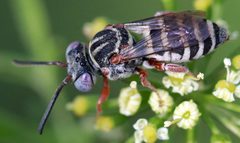
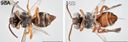
Epeolus pusillus is a cleptoparasitic cuckoo bee in the Apidae, first described by Cresson in 1864. The is a specialized nest of two cellophane bee species in the Colletes: C. compactus and C. ciliatoides. As a cuckoo bee, females lay in nests where their larvae kill the host egg or larva and consume the pollen provisions. The species is known from the United States and Mexico.
Pronunciation
How to pronounce Epeolus pusillus: //ɛˈpiː.ələs pjuːˈsɪl.əs//
These audio files are automatically generated. While they are not always 100% accurate, they are a good starting point.
Identification
Epeolus are generally distinguished from other cuckoo bees by their relatively sparse, short, unbranched or weakly branched body hairs that form distinct color patterns of black, white, red, and yellow. Unlike pollen-collecting bees, they lack the dense hairs used for pollen transport. Specific diagnostic features for E. pusillus relative to other Epeolus species are not documented in available sources.
Images
Distribution
United States and Mexico. Distribution records from GBIF also indicate presence in Middle America (Central America).
Diet
feed on nectar. Larvae consume pollen and nectar provisions stored by bees (Colletes compactus and Colletes ciliatoides).
Host Associations
- Colletes compactus - nest primary ; larvae kill host /larva and consume provisions
- Colletes ciliatoides - nest primary ; larvae kill host /larva and consume provisions
Life Cycle
Cleptoparasitic development: females lay in nests; larvae hatch and kill the host egg or larva, then feed on the pollen and nectar provisions collected by the host female. emerge from host nests.
Behavior
Ecological Role
As a , E. pusillus functions as a regulator of its . The species is part of a specialized ecological interaction involving cellophane bees and their floral resources.
Similar Taxa
- Other Epeolus speciesshare cleptoparasitic lifestyle and general ; distinguished by specific color patterns, hair , and associations
- Nomada speciesalso cleptoparasitic bees in Apidae but belong to different tribe (Nomadini); typically have more -like appearance with different abdominal color patterns
- Epeolus attenboroughicongeneric cuckoo bee described from Colorado and New Mexico; distinguished by specific color pattern differences and geographic range
More Details
Nomenclature
The name 'Epeolus' is thought to be a diminutive of Epeus/Epeius from Greek mythology, the soldier credited with the Trojan Horse—possibly alluding to the deceptive, infiltrating nature of these cleptoparasitic bees.
Conservation status
Not assessed; like many cuckoo bees, likely underrecorded due to rarity relative to and small size (most Epeolus range 5.5–10.0 mm).