
Holcopasites
Ashmead, 1899
cuckoo bees
Species Guides
3- Holcopasites calliopsidis(Calliopsis Cuckoo Nomad Bee)
- Holcopasites minimus(Tiny Furrowed-Cuckoo)
- Holcopasites stevensi(Stevens's Cuckoo Nomad Bee)
Holcopasites is a of small, uncommon cuckoo bees in the Apidae, Nomadinae. The genus contains at least 20 described distributed in North America. All species are obligate that infiltrate the nests of solitary bees to exploit food provisions intended for host offspring. Males are distinguished from nearly all other Apidae by having 12 antennal segments rather than the typical 13.
Pronunciation
How to pronounce Holcopasites: //ˌhɒlkoʊˈpæsaɪtiːz//
These audio files are automatically generated. While they are not always 100% accurate, they are a good starting point.
Identification
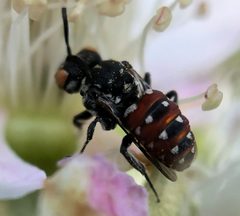
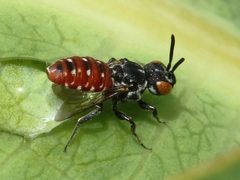
Distinguished from other Apidae by the unique 12-segmented in males. The combination of very small size, red abdominal coloration with white hair patches (in Eastern ), and cuckoo bee aids recognition. Chemical differs from : Holcopasites calliopsidis produces cephalic secretions containing 6-methyl-5-hepten-2-one and geranyl acetone, unlike host mandibular gland compounds.
Images
Habitat
Associated with open supporting . Holcopasites calliopsidis collected at Lime Hollow Nature Center in Cortland, New York. Holcopasites jerryrozeni recorded from Texas Panhandle. Specific microhabitat requirements tied to nesting sites of solitary host bees.
Distribution
North America; Nearctic region. Records include northeastern United States (Vermont, New York), Texas, and broader North American range.
Seasonality
Holcopasites calliopsidis collected in June. Activity synchronized with nesting periods.
Host Associations
- Calliopsis andreniformis - primary ; infiltrates nests to exploit food provisions
- Calliopsis pugionis - of Holcopasites ruthae
- Calliopsis (other species) - two additional
- Nomadopsis - one
Life Cycle
Obligate : infiltrate nests of solitary bees and deposit in host . Offspring develop by consuming food provisions intended for host offspring. Free-living adult stage active during host nesting period. No nest construction or food provisioning by adults.
Behavior
that off-loads all parental care to organisms. infiltrate host nests rather than constructing their own. Chemical profile differs from hosts, suggesting lack of chemical mimicry for host odor.
Ecological Role
that exploits food resources intended for offspring. linked to host abundance and nesting success.
Similar Taxa
Sources and further reading
- BugGuide
- Wikipedia
- GBIF taxonomy match
- iNaturalist taxon
- NCBI Taxonomy
- Catalogue of Life
- Dynamics of a Host-Cleptoparasite Relationship: Holcopasites ruthae as a Parasite of Calliopsis pugionis (Hymenoptera: Anthophoridae, Andrenidae)
- Genome of the bee Holcopasites calliopsidis—a species showing the common apid trait of brood parasitism
- A comparative study of the exocrine products of cleptoparasitic bees (Holcopasites) and their hosts (Calliopsis) (Hymenoptera: Anthophoridae, Andrenidae)
- New Distribution and Ecological Records of the Rare Texas Endemic Species, Holcopasites jerryrozeni (Hymenoptera: Apidae: Nomadinae: Ammobatoidini), in the Texas Panhandle