
Holcopasites calliopsidis
(Linsley, 1943)
Calliopsis Cuckoo Nomad Bee
Holcopasites calliopsidis is a parasitic in the Apidae, Nomadinae. It is a that infiltrates nests of solitary bees, primarily Calliopsis andreniformis, to exploit food provisions intended for host offspring. The is notable for having the smallest known among bees (179 Mb), making it the first brood parasitic bee subject to detailed genomic analysis. It occurs from Mexico to Canada.
Identification
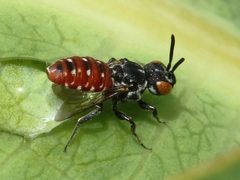
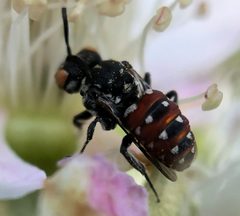
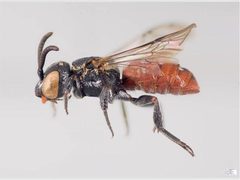
Distinguished from non-parasitic bees by reduced or absent scopal hairs for pollen transport. Separated from other Holcopasites by specific morphological characters not detailed in available sources; H. c. calliopsidis and H. c. carinatus described by Linsley (1943) differ in presumably subtle structural features. Association with Calliopsis andreniformis nests may aid field identification.
Images
Appearance
Habitat
Specific requirements not documented. Specimens have been collected from nature center settings in northeastern North America. Likely associated with open, sandy, or disturbed habitats where Calliopsis andreniformis nests.
Distribution
Mexico to Canada. Present in Middle America and North America. Documented from northeastern North America including New York State.
Seasonality
active in June; specific period duration not documented.
Host Associations
- Calliopsis andreniformis - Primary known ; infiltrates nests to exploit food provisions.
- Pseudopanurgus sp. - probable Suspected based on limited observations; not confirmed.
Life Cycle
parasitic: infiltrate nests of solitary bees and deposit . Larvae develop by consuming food provisions (pollen-nectar stores) intended for host offspring. Adults are free-living; offspring complete development within host nests.
Behavior
of solitary mining bees. do not construct nests or collect provisions. Females locate and enter nests to deposit .
Ecological Role
; dependent on abundance. Does not contribute directly to pollination as lack pollen-collecting structures and do not visit flowers for provisioning.
Human Relevance
Subject of genomic research due to exceptionally small size (179 Mb). No documented economic or agricultural significance.
Similar Taxa
- Holcopasites heliopsisCongeneric cleptoparasitic bees; distinguished by associations and subtle morphological differences.
- Nomada spp.Other Nomadinae ; Holcopasites separated by tribal placement (Ammobatoidini vs. Nomadini) and associated with different groups.
- Calliopsis andreniformis ; non-parasitic with functional scopa and nest-building , easily distinguished by pollen-collecting activity.
More Details
Genomic significance
First parasitic with published draft assembly. Genome size of 179 Mb is smallest known among bees, with 12,364 predicted genes. Small genome not attributable to repetitive loss; 14% comprises unclassified novel repetitive elements possibly showing recent expansion. 212 gene show rapid evolution (15 expansions, 197 contractions).
Subspecies
Two recognized: H. c. calliopsidis (Linsley, 1943) and H. c. carinatus (Linsley, 1943), distinguished by structural features described in original description.