
Calliopsis
Smith, 1853
mining bees, panurgine bees
Species Guides
20- Calliopsis andreniformis(Eastern Miner Bee)
- Calliopsis anomoptera(Strange-winged Calliopsis)
- Calliopsis barbata
- Calliopsis callops
- Calliopsis coloradensis(Colorado Calliopsis Bee)
- Calliopsis filiorum
- Calliopsis fracta
- Calliopsis helianthi
- Calliopsis hesperia
Calliopsis is a of solitary mining bees in the Andrenidae, comprising over 80 described distributed throughout the western hemisphere. These small to medium-sized bees are ground-nesting, with females excavating burrows in sandy or loose soils. The genus includes both polylectic and oligolectic species, with some showing tight specialization to particular pollen such as Prosopis. Several species have been studied in detail for their nesting , foraging , and host- relationships with cleptoparasitic bees.
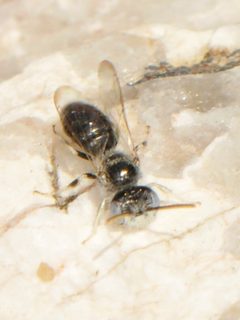
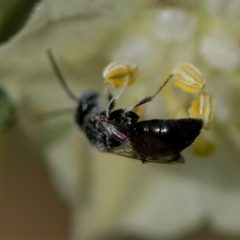
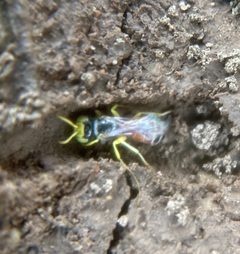
Pronunciation
How to pronounce Calliopsis: /kæˈli.ɒp.sɪs/
These audio files are automatically generated. While they are not always 100% accurate, they are a good starting point.
Identification
Most Calliopsis are small, though males of C. zebrata are notably larger than typical for the . Identification to species level requires examination of morphological characters including facial markings, genitalia, and scopal hairs. The genus can be distinguished from other Andrenidae by panurgine characteristics including the presence of a submarginal in the forewing and specific features of the male genitalia.
Images
Habitat
Sandy or loose soils suitable for ground-nesting; observed in shortgrass prairie, montane meadows, and xeric woodlands. Specific associations include Colorado plains with sandy substrate for C. zebrata, and Chaco forest and Monte scrub in South America for C. laeta.
Distribution
Western hemisphere, including North America (Great Plains, Rocky Mountains, Front Range), Central America, and South America (Argentina, Brazil). Specific records include Colorado Springs and Woodland Park in Colorado, and Anchieta Island in Brazil (though the latter refers to a hermit crab , not the ).
Seasonality
Active primarily in summer months; in Colorado, C. zebrata males observed flying over nesting sites in July. C. pugionis and related studied during active nesting periods. C. laeta active during Prosopis flowering periods in xeric South American woodlands.
Diet
Females collect pollen and nectar for provisioning . C. laeta shows strong association with Prosopis pollen; pollen analysis of nest provisions found only Prosopis in all despite high floral diversity nearby. Most presumed polylectic or oligolectic, though degree of specialization requires further study.
Host Associations
- Prosopis - pollen C. laeta shows tight association; six Prosopis and hybrids recorded as , with two distinct pollen types identified in nest
- Dalea candida - floral visitationfemale Calliopsis sp. observed foraging on White Prairie Clover in Colorado
Life Cycle
Solitary ground-nesting bees; females excavate burrows and construct provisioned with pollen and nectar. Larvae described for C. zebrata. Development includes , larval, and pupal stages within nest cells.
Behavior
Males of some fly relentlessly over nesting sites, landing briefly; male C. zebrata observed in near female nesting areas. Females forage for pollen and nectar, with provisioning studied in C. persimilis. Nesting documented for C. pugionis including construction and investment sex ratios.
Ecological Role
; contribute to pollination of native plants including Prosopis and Dalea. As for cleptoparasitic bees including Holcopasites ruthae, they support higher in .
Similar Taxa
- Colletesboth are ground-nesting bees with cellophane-like nest linings; Colletes females coat with glandular secretions, while Calliopsis lacks this trait
- Lasioglossumboth small ground-nesting bees in similar ; Lasioglossum includes social while Calliopsis is strictly solitary
- Holcopasitescleptoparasitic that attacks Calliopsis nests; females enter burrows and lay , with larvae consuming host provisions
Sources and further reading
- BugGuide
- Wikipedia
- iNaturalist taxon
- NCBI Taxonomy
- Catalogue of Life
- Bug Eric: A Beautiful Place to "Bee"
- Bug Eric: White Prairie Clover: An Awesome Blossom
- Biology of Calliopsis pugionis (Hymenoptera: Andrenidae): Nesting, Foraging, and Investment Sex Ratio
- Bio-ecological aspects of the hermit crab Paguristes calliopsis (Crustacea, Diogenidae) from Anchieta Island, Brazil
- The Solitary Bee Calliopsis zebrata: Biological and Distributional Notes and Description of Its Larva (Hymenoptera: Andrenidae: Panurginae)
- Provisioning behavior and the estimation of investment ratios in a solitary bee, Calliopsis (Hypomacrotera) persimilis (Cockerell) (Hymenoptera: Andrenidae)
- A revision of the bee genes Calliopsis and the biology and ecology of C. andreniformis (Hymen-optera: Andrenidae)
- Dynamics of a Host-Cleptoparasite Relationship: Holcopasites ruthae as a Parasite of Calliopsis pugionis (Hymenoptera: Anthophoridae, Andrenidae)
- A tight relationship between the solitary bee <i>Calliopsis (Ceroliopoeum) laeta</i> (Andrenidae, Panurginae) and <i>Prosopis</i> pollen hosts (Fabaceae, Mimosoideae) in xeric South American woodlands
- A comparative study of the exocrine products of cleptoparasitic bees (Holcopasites) and their hosts (Calliopsis) (Hymenoptera: Anthophoridae, Andrenidae)