
Xenoglossa
Smith, 1854
Squash Bees and Allies, Squash Bees
Species Guides
3- Xenoglossa angustior(Red-tailed Squash Bee)
- Xenoglossa kansensis(Kansas squash bee)
- Xenoglossa strenua(Nimble Squash Bee)
Xenoglossa is a of large bees in the Apidae, commonly known as squash bees. in this genus are oligolectic pollen , with most species foraging exclusively on Cucurbita crops (Cucurbitaceae). Some species, such as X. (Cemolobus) ipomoeae, specialize on Ipomoea (Convolvulaceae) instead. These solitary, ground-nesting bees are native to North America and are important agricultural . are active for a brief period in summer, coinciding with plant bloom.

Pronunciation
How to pronounce Xenoglossa: /ˈzɛnoʊˌɡlɒsə/
These audio files are automatically generated. While they are not always 100% accurate, they are a good starting point.
Identification
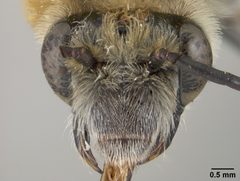
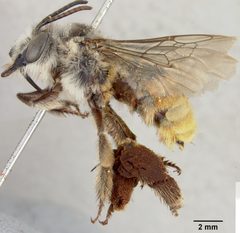
Xenoglossa are large, robust bees with a golden-brown to fuzzy yellow coloration. They can be distinguished from the related Peponapis by subtle morphological differences in facial structure and genitalia. Males of some species have distinctive yellow markings on the . The genus is characterized by its association with cucurbit flowers and early morning foraging activity. Identification to species level requires examination of specific morphological characters and knowledge of plant associations.
Images
Habitat
Ground-nesting in soil, often directly within or adjacent to agricultural fields of plants. Females excavate individual underground nests. Nests are typically located in well-drained soil in sunny locations. Some form loose of nests in suitable .
Distribution
North America; distributed across the United States, Mexico, and southern Canada. Specific distribution varies by . Xenoglossa pruinosa has been studied in Ontario, Canada. Xenoglossa (Cemolobus) ipomoeae was recorded in Bolivar County, Mississippi in 2017, representing a significant southwestern range expansion.
Seasonality
emerge in summer, typically around July, with activity lasting only a few weeks coinciding with plant bloom. Single per year. Most of the is spent underground as immatures, developing until the following summer.
Diet
Oligolectic pollen . Most forage exclusively on Cucurbita (Cucurbitaceae), including pumpkins, squash, gourds, cucumbers, and zucchini. Xenoglossa (Cemolobus) ipomoeae specializes on Ipomoea pandurata (Convolvulaceae) and potentially related Ipomoea species. feed on nectar; females collect pollen on scopal hairs on the hind legs to provision .
Host Associations
- Cucurbita crops (Cucurbitaceae) - pollen sourcePrimary for most Xenoglossa ; includes pumpkins, squash, gourds, cucumbers, zucchini
- Ipomoea pandurata (Convolvulaceae) - pollen source for Xenoglossa (Cemolobus) ipomoeae; potentially other Ipomoea
- Triepeolus remigatus - Cleptoparasitic (Apidae: Epeolini) that parasitizes nests of Xenoglossa pruinosa
Life Cycle
Solitary ground-nesting with . Females excavate underground nests and construct individual provisioned with pollen. Single per year: emerge in summer, mate, and females provision nests. Offspring develop underground through , larval, and pupal stages, as immatures and emerging the following summer.
Behavior
Early morning foragers, beginning pollination activity before sunrise when cucurbit flowers open. Males of some sleep in blossoms overnight. Females exhibit minimal aggression toward conspecifics and nest . When parasitized by Triepeolus remigatus, display tolerant and avoidant rather than aggressive responses. exposure can induce hyperactivity and alter foraging .
Ecological Role
Key of Cucurbita crops, contributing to production of pumpkins, squash, and related agricultural products. Native pollinator that was important for of cucurbits before European contact. Serves as for cleptoparasitic bees, contributing to understanding of host- dynamics in ground-nesting bees.
Human Relevance
Important agricultural for cucurbit crops. Proposed as a model organism for assessing effects on ground-nesting solitary bees. Vulnerable to pesticide exposure, including '-safe' and , with documented sublethal effects on and . Some have declined, potentially due to pesticide sensitivity.
Similar Taxa
- PeponapisRelated of squash bees in tribe Eucerini; also oligolectic on Cucurbita. Distinguished by subtle morphological differences including facial structure and male genitalia. Both genera share 'squash bee' and similar .
- EuceraClosely related ; Xenoglossa has been treated as a subgenus of Eucera in some classifications (NCBI). Distinguished by plant specialization and morphological characters.
More Details
Pesticide Sensitivity
Xenoglossa pruinosa has been demonstrated to suffer sublethal effects from labeled as '-safe', including flupyradifurone (Sivanto Prime) and the Quadris Top. Combined pesticide exposure induces hyperactivity and reduces offspring production, highlighting the importance of testing effects on ground-nesting bees specifically.
Taxonomic Notes
The contains approximately 11 described according to some sources, though counts vary. Xenoglossa (Cemolobus) ipomoeae represents a distinct subgenus with divergent plant association (Ipomoea rather than Cucurbita). Xenoglossa pruinosa was formerly placed in genus Peponapis as P. pruinosa.
Sources and further reading
- BugGuide
- Wikipedia
- GBIF taxonomy match
- iNaturalist taxon
- NCBI Taxonomy
- Catalogue of Life
- Happy National Squash Bee Day! | Bug Squad
- Thank the Squash Bee for That Pumpkin Pie | Bug Squad
- Host-parasite interactions between Xenoglossa pruinosa (Apidae: Eucerini) and Triepeolus remigatus (Apidae: Epeolini) are characterized by tolerance and avoidance
- Single and combined exposure to ‘bee safe’ pesticides alter behaviour and offspring production in a ground-nesting solitary bee ( Xenoglossa pruinosa )
- First record of <i>Xenoglossa </i>(<i>Cemolobus</i>) <i>ipomoeae </i>(Robertson, 1891) in Mississippi: Distribution, ecology, and conservation implications