
Peponapis pruinosa
(Say, 1837)
eastern cucurbit bee, squash bee, hoary squash bee
Peponapis pruinosa is a solitary ground-nesting specialized on cucurbits (squash, pumpkins, and gourds). It is an oligolege, collecting pollen exclusively from Cucurbita . The species expanded its range dramatically following human of squash throughout North America. It is an effective of cultivated cucurbits and often completes its entire within agricultural fields.
Pronunciation
How to pronounce Peponapis pruinosa: /pɛ.poʊˈneɪ.pɪs pruˈɪ.noʊ.sə/
These audio files are automatically generated. While they are not always 100% accurate, they are a good starting point.
Identification
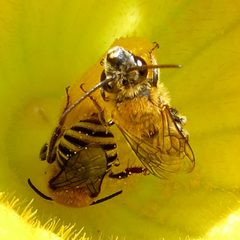
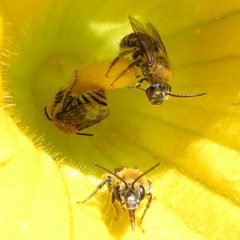
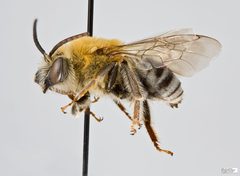
Distinguished from other bees by exclusive association with Cucurbita flowers. Males of Eucerini have long , but P. pruinosa specifically tracks squash flower —active early morning when flowers open, resting inside closed flowers after noon. Females have conspicuous pollen loads on hind legs when foraging. Distinguished from co-occurring Xenoglossa squash bees by subtle morphological differences and geographic patterns.
Images
Appearance
11–14 mm long, 4–5.5 mm wide at . Black body with whitish bands on abdomen. Coated in yellowish hairs. Females possess branched scopae on hind legs for transporting large, coarse cucurbit pollen. Males lack scopae. Wings show -level morphometric variation across North America.
Habitat
Agricultural fields growing cucurbits, particularly squash, pumpkins, and gourds. Also found near wild Cucurbita including C. foetidissima. Nests in ground, favoring irrigated soils, fire-cleared areas, and lawns. Nests documented to 46 cm depth, though offspring usually placed shallower.
Distribution
North America from Atlantic to Pacific coasts of the United States, south through Mexico to Central America (Honduras, Nicaragua, Panama). Range expanded historically from southwestern origin following human agricultural of plants. Eastern derived from Midwest founder events; western populations (California, Great Basin) differentiated and isolated by the Rocky Mountains.
Seasonality
Activity tied to Cucurbita flowering . active when squash flowers open early morning; nest building occurs later in day. occurs late June to early July. complete synchronized with crop cycles.
Diet
Females collect pollen and nectar exclusively from Cucurbita (oligolectic). Males forage for nectar at Cucurbita flowers. Occasional nectar visits to other plant types recorded, but offspring provisioned solely with Cucurbita pollen.
Host Associations
- Cucurbita pepo - pollen cultivated and wild forms
- Cucurbita moschata - pollen cultivated
- Cucurbita maxima - pollen cultivated
- Cucurbita foetidissima - pollen wild buffalo gourd; native supporting natural range expansion
Life Cycle
Solitary ground-nester. Females excavate nests near plants, provisioning individual with Cucurbita pollen. Larvae develop in cells, pupate in late June–early July. Unimodal or partially depending on local climate and crop . stage as or pupa in soil.
Behavior
Strictly with activity synchronized to Cucurbita flower schedule: foraging early morning, nest construction afternoon. Males spend nearly entire lives in and around flowers—foraging, mating in open blossoms, and sleeping inside closed flowers after noon. Females maintain one or more nests during nesting season, sometimes plugging nest entrances and constructing tumuli. Demonstrates preference for tilled soils in choice experiments, though tillage negatively impacts survival.
Ecological Role
Primary of cultivated cucurbits; fields with healthy achieve complete pollination without managed honey bees. mutualist with Cucurbita. Serves as model organism for ground-nesting ecotoxicology due to agricultural association and soil-nesting habit.
Human Relevance
Economically important of squash, pumpkin, and gourd crops. More efficient than honey bees for these specific crops. Vulnerable to agricultural practices: tillage reduces by up to two-thirds; (neonicotinoids) pose chronic exposure risks through contaminated soil. Used as for pollinator protection planning in agroecosystems.
Similar Taxa
- Xenoglossa speciesAlso specialized squash bees, co-occur on Cucurbita; distinguished by subtle morphological differences and or parapatric distribution patterns
- Bombus impatiensEffective alternative of cucurbits, particularly pumpkins; bumblebee distinguished by social colony structure, larger size, and buzz-pollination
- Other Eucerini (Melissodes, etc.)Share long-horned male and solitary ground-nesting habit, but are polylectic not tied to Cucurbita
Misconceptions
The 'squash ' applies to multiple in Peponapis and Xenoglossa; P. pruinosa specifically is the 'eastern cucurbit bee.' Despite demonstrated preference for tilled soils in short-term choice experiments, long-term persistence is severely reduced by tillage—preference does not equal benefit.
More Details
Range expansion history
Molecular and morphometric evidence supports western North American origin with natural expansion following wild buffalo gourd (Cucurbita foetidissima) during hypsithermal period; subsequent dramatic range expansion tracking human of mesophytic Cucurbita . Eastern established through serial founder events from Midwest source, not coastal routes. Western populations (California, Great Basin) represent recent, genetically isolated events.
Conservation concerns
Used as model for ground-nesting risk assessment. Neonicotinoid residues in agricultural soil exceed thresholds; clothianidin and imidacloprid pose greatest risks. No-till agriculture and reduced pesticide applications recommended for persistence.
Sources and further reading
- BugGuide
- Wikipedia
- GBIF taxonomy match
- Catalogue of Life
- Why Wild Bees Are in Trouble | Bug Squad
- UC Davis Scientists Weigh in on 'The Plight of the Pollinators' | Bug Squad
- A Push to Protect Pollinators | Bug Squad
- Pollination Ecologist Neal Williams: The Importance of Native Bees | Bug Squad
- 'Am I Even a Bee?' Identity Crisis Unfolds in This Charming Book | Bug Squad
- The Native Bees in the UC Davis Bee Haven | Bug Squad
- Preference of Peponapis pruinosa (Hymenoptera: Apoidea) for Tilled Soils Regardless of Soil Management System
- Ecology of the squash and gourd bee, Peponapis pruinosa, on cultivated cucurbits in California (Hymenoptera: Apoidea)
- Crop domestication facilitated rapid geographical expansion of a specialist pollinator, the squash beePeponapis pruinosa
- Differentiation and Range Expansion of North American Squash Bee, Peponapis Pruinosa (Apidae: Apiformes) Populations Assessed by Geometric Wing Morphometry
- Assessment of risk to hoary squash bees (Peponapis pruinosa) and other ground-nesting bees from systemic insecticides in agricultural soil
- Assessment of risk to hoary squash bees ( Peponapis pruinosa ) and other ground-nesting bees from systemic insecticides in agricultural soil