
Peponapis
Robertson, 1902
Squash bees
Species Guides
2- Peponapis crassidentata
- Peponapis pruinosa(eastern cucurbit bee)
Peponapis is a of ground-nesting bees in the Apidae, commonly known as squash bees. These solitary bees are specialized of plants in the family Cucurbitaceae, including squash, pumpkins, gourds, and cucumbers. The genus underwent rapid geographical expansion following the domestication and spread of cucurbit crops by humans. Peponapis pruinosa, the most studied , has been used as a model organism for understanding the impacts of agricultural practices on ground-nesting bees and for assessing risk in agricultural soils.
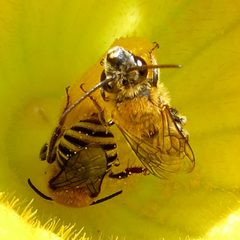
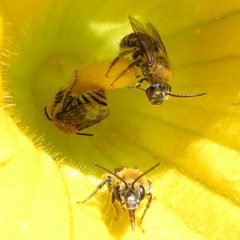
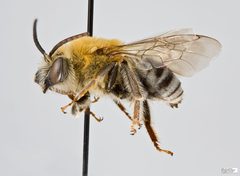
Pronunciation
How to pronounce Peponapis: //pɛpəˈneɪpɪs//
These audio files are automatically generated. While they are not always 100% accurate, they are a good starting point.
Identification
Peponapis can be distinguished from similar bees by their specialized association with cucurbit flowers. They are solitary, ground-nesting bees that forage primarily at dawn when cucurbit flowers open. Males often sleep in wilted flowers. The is closely related to Xenoglossa, with which it shares the 'squash bee,' though they are distinct genera.
Images
Habitat
Agricultural fields and gardens where cucurbit crops are cultivated; also associated with wild cucurbit . Nests are excavated in soil, with documented preference for tilled soils in agricultural settings. The has expanded its range following human of cultivated cucurbits.
Distribution
North America, with range expansion from original distribution in Mexico and the southwestern United States to temperate regions across the continent. east of the Rocky Mountains expanded from the wild plant's range in Mexico through founder events. Western populations show two genetically differentiated groups: one in California and another in the eastern Great Basin.
Seasonality
Activity coincides with the flowering period of cucurbit , typically summer months when squash, pumpkins, and related crops are in bloom. Bees are most active at dawn when cucurbit flowers open.
Diet
of Cucurbitaceae; collects pollen and nectar exclusively from cucurbits (squash, pumpkins, gourds, cucumbers, and related plants). This narrow pollen specialization is termed oligolecty.
Host Associations
- Cucurbitaceae (cucurbits) - Specialized pollen and nectar source; includes cultivated and wild
- Cucurbita pepo - Cultivated squash and pumpkins
- Cucurbita foetidissima - Wild buffalo gourd; hypothesized original for range expansion
Life Cycle
Solitary ground-nesting bees. Females excavate nests in soil, with documented preference for disturbed or tilled soils. Development includes , larva, pupa, and stages. Specific details of developmental timing and construction require further documentation.
Behavior
Specialized dawn-foraging coinciding with cucurbit flower opening. Males frequently aggregate in wilted flowers to sleep. Shows strong nesting site fidelity to tilled agricultural soils regardless of soil management system. Range expansion has tracked human agricultural of plants through repeated bottleneck events.
Ecological Role
of economically important cucurbit crops. Demonstrates mutualistic relationship between agricultural expansion and pollinator range dynamics. Contributes to crop pollination services valued at billions of dollars annually. Serves as an important model for understanding ground-nesting and risk assessment.
Human Relevance
Critical of squash, pumpkin, and cucumber crops. Used as a model organism in ecological research on agricultural impacts on native pollinators and in risk assessment for ground-nesting bees. The expansion of its range demonstrates how agricultural practices can drive range dynamics in pollinators.
Similar Taxa
- XenoglossaAlso called 'squash bees' and specialized on cucurbits; distinct in the same tribe Eucerini, with which Peponapis shares but differs in morphological and genetic characteristics
- Apis mellifera that visits cucurbits but lacks the specialized oligolectic foraging and dawn activity pattern of Peponapis
- Bombus spp. bumble bees that may visit cucurbit flowers but are not specialized on this plant and have different nesting (social colonies above ground or in cavities)
More Details
Taxonomic Note
Peponapis has been treated variously as a full or as a subgenus of Eucera or Xenoglossa in different taxonomic systems. Catalogue of Life accepts it as a genus, while NCBI lists it as a subgenus of Eucera. Robertson (1902) originally described the genus.
Conservation Concern
Peponapis pruinosa has been identified as vulnerable to agricultural practices including tillage and exposure. Risk assessment studies show chronic exposure to neonicotinoid in agricultural soil exceeds acceptable thresholds for this . The species' preference for tilled soils may increase its exposure to soil-applied pesticides.
Sources and further reading
- BugGuide
- Wikipedia
- iNaturalist taxon
- NCBI Taxonomy
- Catalogue of Life
- Why Wild Bees Are in Trouble | Bug Squad
- 'Am I Even a Bee?' Identity Crisis Unfolds in This Charming Book | Bug Squad
- The Native Bees in the UC Davis Bee Haven | Bug Squad
- UC Davis Scientists Weigh in on 'The Plight of the Pollinators' | Bug Squad
- A Push to Protect Pollinators | Bug Squad
- Pollination Ecologist Neal Williams: The Importance of Native Bees | Bug Squad
- Preference of Peponapis pruinosa (Hymenoptera: Apoidea) for Tilled Soils Regardless of Soil Management System
- Ecology of the squash and gourd bee, Peponapis pruinosa, on cultivated cucurbits in California (Hymenoptera: Apoidea)
- Crop domestication facilitated rapid geographical expansion of a specialist pollinator, the squash beePeponapis pruinosa
- Assessment of risk to hoary squash bees ( Peponapis pruinosa ) and other ground-nesting bees from systemic insecticides in agricultural soil
- Differentiation and Range Expansion of North American Squash Bee, Peponapis Pruinosa (Apidae: Apiformes) Populations Assessed by Geometric Wing Morphometry
- Ecological niche modeling and geographical distribution of pollinator and plants: A case study of Peponapis fervens (Smith, 1879) (Eucerini: Apidae) and Cucurbita species (Cucurbitaceae)
- Assessment of risk to hoary squash bees (Peponapis pruinosa) and other ground-nesting bees from systemic insecticides in agricultural soil