
Bombus vancouverensis
Cresson, 1878
Vancouver Bumble Bee, Vancouver Island Bumblebee
Species Guides
2- Bombus vancouverensis nearcticus(Nearctic Bumble Bee)
- Bombus vancouverensis vancouverensis(Vancouver Island Bumble Bee)
Bombus vancouverensis is a eusocial bumblebee of subgenus Pyrobombus, widespread across mountainous regions of western North America. The was long treated as synonymous with Bombus bifarius, with most historical literature on bifarius actually referring to vancouverensis. Genetic studies completed in 2020 confirmed their distinct status, with true B. bifarius being exclusively red-tailed and geographically restricted, while B. vancouverensis is polymorphic and broadly distributed. It is one of only two bumblebee species known to use for kin recognition.

Pronunciation
How to pronounce Bombus vancouverensis: /ˈbɒm.bəs vænˈkuː.vəˌrɛn.sɪs/
These audio files are automatically generated. While they are not always 100% accurate, they are a good starting point.
Identification
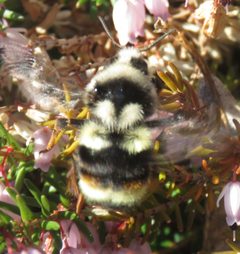
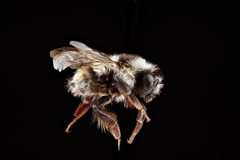
Distinguished from true Bombus bifarius by genetic differentiation; B. bifarius is exclusively red-tailed and much more geographically restricted, while B. vancouverensis is polymorphic and widely distributed. The black-tailed form was historically attributed to B. bifarius nearcticus but is now recognized as B. vancouverensis. Both forms occur from Utah and Wyoming north through western Canada and Alaska, though the black-tailed form is far more common. Small body size and short distinguish it from larger bumblebee . Facial hair coloration (yellow/white with possible black on top) and the black band on the lower are consistent features across color morphs.
Images
Habitat
Montane regions of western North America. Nests are constructed underground or on the ground surface, often small with a single open chamber; also uses abandoned rodent nests. Found in open grassy fields, parks, prairies, shrublands, and mountainous areas. Occupies diverse elevations across its range.
Distribution
Western North America from Alaska and Yukon south through western Canada (Alberta, British Columbia, Manitoba, Northwest Territories, Saskatchewan) and the western United States (California, Idaho, Montana, Nevada, Oregon, South Dakota, Utah, Washington, Wyoming). Two : B. v. vancouverensis limited to British Columbia, and B. v. nearcticus widespread across the United States and Canada.
Seasonality
colony cycle with queens emerging from hibernation in early spring to found colonies. Eusocial phase follows with production and colony growth. Reproductive phase produces sexual offspring that mate; inseminated queens enter hibernation until the following spring.
Diet
Forages for pollen and nectar from diverse plant including Aster, Centaurea, Chrysothamnus, Cirsium, Epilobium, Ericameria, Haplopappus, Helenium, Lupinus, Melilotus, Monardella, Penstemon, Ribes, Senecio, Solidago, and Symphoricarpos.
Life Cycle
colony cycle. Queens emerge from hibernation in early spring and found one colony per . First initiates the eusocial phase with exponential colony growth. Workers assist in colony expansion. The eusocial phase transitions to a reproductive phase producing sexual offspring (males and new queens). These mate with non-nestmates; inseminated queens hibernate until the following spring to found new colonies.
Behavior
Queens mate once per colony cycle, preferentially with non-related males. Mating interactions are prolonged, lasting up to forty-five minutes, suggesting mate guarding where males prevent rival copulation. Males exhibit patrolling behavior, marking paths with to attract reproductive females. One of only two bumblebee known to use individually-borne pheromone signals for kin recognition, facilitating inbreeding avoidance. regulate nest temperature through wing fanning (cooling) and incubation (heating), with individual variation in temperature thresholds for these behaviors. Foragers move in random directions and assess flower quality visually to avoid revisiting depleted blooms. Uses buzz pollination, often hanging upside-down due to small body size. Some workers specialize exclusively on nectar or pollen collection throughout their foraging careers, with gathering more food than .
Ecological Role
Important in montane and adjacent . Provides pollination services for wild flowering plants and contributes to plant structure and . Buzz pollination capability allows access to pollen from flowers with poricidal anthers. Serves as food source for and . Genetic studies indicate local to temperature, elevation, and other across its broad range, suggesting potential role in ecosystem to environmental change.
Human Relevance
Contributes to pollination of wild plants and potentially agricultural crops in western North America. Subject of genomic research due to its abundance and broad distribution, with high-quality assembly available. Historical taxonomic confusion with B. bifarius complicated conservation and research efforts until 2020 genetic clarification. Common enough to be regularly encountered by citizen scientists and researchers in western North America.
Similar Taxa
- Bombus bifariusHistorically confused with B. vancouverensis; true B. bifarius is exclusively red-tailed and geographically restricted, while B. vancouverensis is polymorphic (red-tailed and black-tailed forms) and broadly distributed. Genetic differentiation confirmed in 2020.
- Bombus frigidusThe only other bumblebee known to use for kin recognition; shares this distinctive behavioral trait but differs in distribution and preferences.
Misconceptions
Long treated as synonymous with Bombus bifarius, resulting in nearly all historical literature on bifarius actually referring to vancouverensis. The black-tailed form was formerly considered B. bifarius nearcticus. This taxonomic confusion persisted until 2020 when genetic studies confirmed -level distinction.
More Details
Genomic resources
High-quality de novo assembly available (N50 >2.2 Mb, >98% BUSCO completeness, 13,325–13,687 annotated genes), generated from a specimen collected in Sequoia National Park, California at 2,214 m elevation. Genome shows high synteny with Bombus terrestris.
Subspecies
Two recognized : Bombus vancouverensis vancouverensis (Vancouver Island Bumblebee), limited to British Columbia; and Bombus vancouverensis nearcticus (Nearctic Bumblebee), widespread across the United States and Canada.
Local adaptation
Whole- sequencing reveals environment-associated genetic divergence across its range, with outlier SNPs associated with isothermality and elevation. Candidate genes under selection include those involved in neuromuscular function, ion , oxidative stress, and hypoxia response, potentially facilitating to temperature, desiccation, and high-elevation conditions.
Sources and further reading
- BugGuide
- Wikipedia
- GBIF taxonomy match
- iNaturalist taxon
- NCBI Taxonomy
- Catalogue of Life
- Celebrating Bumble Bees on World Bee Day | Bug Squad
- Bumble Bee Mellowing Out on the Mallow | Bug Squad
- The Buzz: Protecting Our Bumble Bees | Bug Squad
- California Has No State Bee--Yet! | Bug Squad
- Saving California's Bumble Bees: Become a Citizen Scientist | Bug Squad
- Bumble Bees: Feeling Impact of Climate Change | Bug Squad
- De Novo Genome Assemblies for Three North American Bumble Bee Species: Bombus bifarius, Bombus vancouverensis, and Bombus vosnesenskii
- Whole Genome Sequencing Reveals the Structure of Environment-Associated Divergence in a Broadly Distributed Montane Bumble Bee, Bombus vancouverensis