
Bombus bifarius
Cresson, 1879
Two-form bumblebee
Bombus bifarius is a eusocial of the subgenus Pyrobombus, first described by Cresson in 1879. Recent genetic research (2020) has clarified its : what was historically considered a single with two color morphs (red-tailed 'bifarius' and black-tailed 'nearcticus') has been split into two cryptic species. True B. bifarius is now restricted to the red-tailed form found in the southern Rocky Mountains, while the black-tailed and variable forms belong to the sister species Bombus vancouverensis. The species is small-bodied and has been identified as one of only two bumble bee species known to use in kin recognition.
Pronunciation
How to pronounce Bombus bifarius: /ˈbɔmbus bɪˈfæriʊs/
These audio files are automatically generated. While they are not always 100% accurate, they are a good starting point.
Images
Appearance
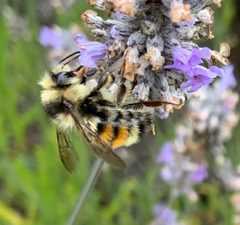
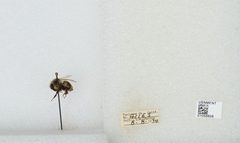
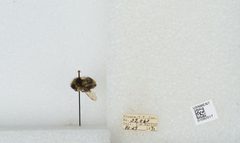
measure 8–14 mm; queens 15–19 mm. Body covered with short, even hair. hairs yellow or white, sometimes with black on top of . Lowermost third of has black coloration. Hindlegs and brownish-orange. Metasomal tergites 2 and 3 have red hairs—the diagnostic coloration of true B. bifarius. Males similar in size to workers (8–13 mm) with comparable size and coloration.
Distribution
Restricted to mountainous regions of the southern Rocky Mountains: northern Arizona, Colorado, northern New Mexico, Utah, and southern Wyoming. Formerly thought to range across western North America, but in British Columbia, Alaska, California, Oregon, Idaho, Montana, Washington, and northern Wyoming have been reassigned to Bombus vancouverensis.
Ecological Role
Important in montane . As a , performs buzz pollination (sonication) to dislodge pollen from flowers. One of two bumble bee documented to use in kin recognition (the other being Bombus frigidus).
Similar Taxa
- Bombus vancouverensisFormerly confused with B. bifarius due to historical classification as color morphs. B. vancouverensis includes black-tailed and variable color forms; true B. bifarius is restricted to red-tailed specimens in the southern Rocky Mountains. Genetic divergence confirmed in 2020.
Misconceptions
The 'two-form bumblebee' is a historical misnomer. The was believed to exhibit two color (red-tailed and black-tailed), but genetic studies revealed these represent separate species. True B. bifarius only has the red-tailed form and is not 'two-formed.'
Sources and further reading
- BugGuide
- Wikipedia
- GBIF taxonomy match
- iNaturalist taxon
- NCBI Taxonomy
- Catalogue of Life
- Bumble Bees: Feeling Impact of Climate Change | Bug Squad
- Look Out, Franklin's Bumble Bee, They're Coming for You! | Bug Squad
- Celebrating Bumble Bees on World Bee Day | Bug Squad
- Bumble Bee Mellowing Out on the Mallow | Bug Squad
- The Buzz: Protecting Our Bumble Bees | Bug Squad
- California Has No State Bee--Yet! | Bug Squad
- De Novo Genome Assemblies for Three North American Bumble Bee Species: Bombus bifarius, Bombus vancouverensis, and Bombus vosnesenskii
- Thresholds of Response in Nest Thermoregulation by Worker Bumble Bees, Bombus bifarius nearcticus (Hymenoptera: Apidae)
- Substantial genetic divergence and lack of recent gene flow support cryptic speciation in a colour polymorphic bumble bee ( Bombus bifarius ) species complex