
Phylloxera glabra
(von Heyden, 1837)
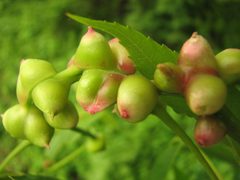
Phylloxera glabra is a of phylloxeran, a group of small, soft-bodied insects closely related to aphids within the Phylloxeridae. Like other phylloxerans, this species induces gall formation on plants through chemical secretions that manipulate plant tissue development. The species was described by von Heyden in 1837 and has been recorded from parts of Europe including Belgium, Denmark, and Norway. Phylloxerans exhibit complex involving multiple and both sexual and parthenogenetic .


Pronunciation
How to pronounce Phylloxera glabra: /fɪˈlɔksɪərə ˈɡleɪbrə/
These audio files are automatically generated. While they are not always 100% accurate, they are a good starting point.
Images
Distribution
Recorded from Belgium (including Brussels-Capital Region and Flemish Region), Denmark, and Norway based on GBIF distribution records.
Diet
Phylloxerans feed on plant sap using , inducing gall formation on plant tissues.
Life Cycle
As with other phylloxerans, the likely involves as , spring of nymphs during bud break, gall induction on new growth, development within galls, and emergence of winged . Some phylloxeran produce multiple per season with both parthenogenetic and phases.
Behavior
Induces gall formation on plants through chemical secretions during feeding; galls provide shelter and food source for developing nymphs.
Ecological Role
As a gall-forming insect, modifies plant tissue development creating specialized microhabitats; may serve as food source for and .
Similar Taxa
- Phylloxera caryaecaulisBoth are phylloxeran that induce galls on plants; P. caryaecaulis specifically attacks hickory (Carya) species while P. glabra has different host associations.
- Daktulosphaira vitifoliae (grape phylloxera)Both belong to Phylloxeridae and share gall-forming , though grape phylloxera is economically significant and has been more extensively studied; P. glabra is not associated with grapevines.
More Details
Taxonomic note
Phylloxera glabra was described by von Heyden in 1837. The Phylloxera contains multiple , some of which are significant agricultural pests (notably grape phylloxera), while others such as P. glabra have received less research attention.
Sources and further reading
- BugGuide
- GBIF taxonomy match
- iNaturalist taxon
- Catalogue of Life
- Insects and mites that feed on leaves - AgriLife Extension Entomology
- Managing Insect and Mite Pests of Commercial Pecans in Texas - AgriLife Extension Entomology
- Meet 'The Moth Man' at Bohart Museum's Moth Night | Bug Squad
- Gall darn it! Gall insects on hickory, oak, and elm, Phylloxera caryaecaulis, Andricus palustris, Colopha ulmicola — Bug of the Week
- The Insects Behind the Weird Growths on Plants
- How Some Insects Turn Plants Into Pollution Detectors