
Phenacoccus solani
Ferris, 1918
Solanum Mealybug
Phenacoccus solani, commonly known as the solanum mealybug, is a parthenogenetic mealybug in the Pseudococcidae. It reproduces via , with females producing viable offspring without males. The species has a broad range including plants in Solanaceae, Amaryllidaceae, and Compositae families, and is recognized as a pest of tomato, cotton, and ornamental plants. Historically confused with P. defectus due to morphological similarity, molecular and morphometric analyses confirmed these as in 2016, with P. defectus synonymized under P. solani. The species has a distribution spanning the Nearctic, Mediterranean basin, Asia, South America, Africa, Australia, and Pacific islands.
Pronunciation
How to pronounce Phenacoccus solani: /ˌfɛnəˈkɒkəs səˈlɑːnaɪ/
These audio files are automatically generated. While they are not always 100% accurate, they are a good starting point.
Identification
Microscopic morphological examination of females is required for -level identification; slide-mounting is the standard taxonomic method. Distinguished from similar Phenacoccus species by detailed morphological characters of the adult female, though significant intraspecific variation exists. Molecular analysis of COI and 28S genes can confirm identification. Previously confused with P. defectus, but integrated morphometric and molecular analyses showed continuous morphological variation and identical molecular grouping, confirming conspecificity.
Images
Appearance
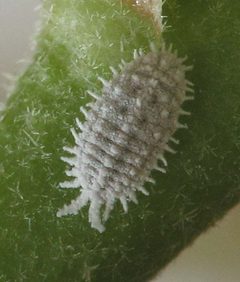
females exhibit typical mealybug with soft, oval bodies covered in white, powdery, meal-like wax secretions. Morphological characteristics show significant intraspecific variation that previously led to misidentification as separate . Detailed microscopic examination of adult female morphological characters is required for definitive identification. The species lacks the distinctive green reaction to potassium hydroxide that characterizes some other mealybug species like Nipaecoccus viridis.
Habitat
Found on above-ground plant parts including leaves, stems, and fruits of plants; no evidence of root-feeding in available sources. Occurs in agricultural settings, ornamental plantings, and natural vegetation. In Israel, recorded from Coastal Plain and Arava Valley .
Distribution
distribution including: Nearctic region (type locality), United States, Canada, Mexico, Guatemala, Caribbean (Puerto Rico, Trinidad and Tobago, Netherlands Antilles), South America (Brazil, Peru, Venezuela, Ecuador), Mediterranean basin (Italy, Spain, Turkey, Sicily, Israel), Europe (Britain, France), Asia (China, Japan, Korea), Africa (South Africa, Zimbabwe, Ethiopia), Australia, and Pacific islands (Hawaiian Islands, Marshall Islands, Kiribati).
Diet
Phloem-feeding on plant sap; specific feeding mechanism involves to access vascular tissues.
Host Associations
- Solanum - primary (implied by epithet)Solanaceae
- Lycoris radiata - Amaryllidaceae; recorded in China
- tomato - agricultural
- cotton - agricultural
- ornamental plants -
- succulent plants -
- Compositae - recorded in Israel
Life Cycle
Developmental stages: (5-6 days), three nymphal instars (first instar 6-7 days, second instar 5-6 days, third instar 6-7 days), . Total development from egg to adult approximately 22-26 days at 26-27°C. Adult pre-oviposition period: 5-6 days. Oviposition period: 20-30 days. : 300-400 eggs per female. All data from controlled laboratory conditions.
Behavior
Reproduces via ; females isolated at any developmental stage from first instar to produce viable offspring without males. No males have been observed in laboratory cultures. with laid in protected locations on plants.
Ecological Role
Herbivorous pest causing direct damage through phloem feeding, resulting in reduced plant vigor, , and potential yield loss. Indirect damage through honeydew promoting growth. Serves as for including Anagyrus (Hymenoptera: Encyrtidae).
Human Relevance
Agricultural pest of tomato and cotton; pest of ornamental plants and succulents in nursery and landscape settings. Subject of research due to its parthenogenetic and potential. Interceptions recorded in contexts.
Similar Taxa
- Phenacoccus defectusHistorically confused with P. solani due to overlapping morphological variation; synonymized in 2016 based on morphometric and molecular evidence
- Nipaecoccus viridisSimilar appearance as white, waxy mealybug; distinguished by green reaction to KOH in N. viridis versus no green reaction in P. solani
More Details
Taxonomic history
described by Ferris in 1918. Phenacoccus defectus Ferris was described as a separate species but synonymized under P. solani in 2016 based on canonical variates morphological analysis of 199 specimens and molecular analysis of COI and 28S genes showing continuous variation and identical clade grouping.
Reproductive biology
is the normal and apparently sole mode of ; no males have been documented despite extensive laboratory rearing. This reproductive strategy facilitates rapid establishment and spread, contributing to potential.
Parasitoid associations
Documented as for Anagyrus (Hymenoptera: Encyrtidae), including a newly described species from China parasitizing P. solani on Lycoris radiata.
Sources and further reading
- BugGuide
- Wikipedia
- GBIF taxonomy match
- iNaturalist taxon
- NCBI Taxonomy
- Catalogue of Life
- Hans Herren: Why Sustainable Farming That Works With Nature Is Crucial | Bug Squad
- Publications | Entomology Research Museum
- Katja Poveda: Zeroing in on Plant-Insect Interactions | Bug Squad
- Green Light: New ID Test Ready for Invasive Mealybug Pest
- Hemp Pests Documented in New Guide for Florida Growers
- Small Farms: On the Front Lines of Emerging Agricultural Pests
- Parthenogenesis in the Mealybug, Phenacoccus solani Ferris
- Are Phenacoccus solani Ferris and P. defectus Ferris (Hemiptera: Pseudococcidae) distinct species?
- Note: The solanum mealybug,Phenacoccus solani ferris (Hemiptera: Coccoidea: Pseudococcidae), extends its distribution range in the mediterranean basin
- Development and reproduction of an exotic pest mealybug, Phenacoccus solani (Homoptera: Pseudococcidae) at three constant temperatures
- Correction to: A new species of Anagyrus (Hymenoptera: Encyrtidae) from China, parasitoid of Phenacoccus solani Ferris (Hemiptera: Pseudococcidae) on Lycoris radiata (L’Her.) Herb.
- A new species of Anagyrus (Hymenoptera: Encyrtidae) from China, parasitoid of Phenacoccus solani Ferris (Hemiptera: Pseudococcidae) on Lycoris radiata (L’Her.) Herb.