
Essigella
Del Guercio, 1909
American Pine Needle Aphids
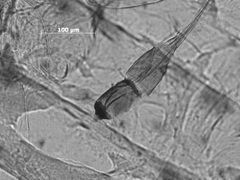
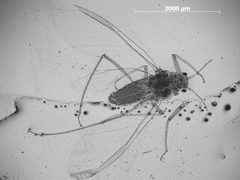
Essigella is a of aphids in the Aphididae, commonly known as American pine needle aphids. in this genus are specialized feeders on Pinaceae, particularly Pinus species. Essigella californica, the type species and most well-known member, is native to western North America and has become an pest in Australia and New Zealand, where it affects commercial pine plantations. The genus is characterized by its association with conifer and its potential to cause defoliation and reduced tree growth.

Pronunciation
How to pronounce Essigella: /ˌɛsɪˈɡɛlə/
These audio files are automatically generated. While they are not always 100% accurate, they are a good starting point.
Images
Habitat
Coniferous forests and plantations, primarily on Pinus . In invaded regions, found in Monterey pine (Pinus radiata) plantations.
Distribution
Native to western North America. Introduced and established in Australia and New Zealand, where it has spread to most pine-growing areas.
Diet
Phloem sap from Pinaceae, particularly Pinus .
Host Associations
- Pinus radiata - primary Commercially important in invaded regions (Australia, New Zealand)
- Pinaceae - Native in western North America
Behavior
Causes defoliation of trees; densities vary significantly based on climatic conditions and site characteristics.
Ecological Role
Forest pest that reduces tree growth and diameter increment; associated with increased of needlecast fungus Cyclaneusma minus; considered to have lower pest status in New Zealand compared to Australia.
Human Relevance
Significant forestry pest in Australia and New Zealand, affecting commercial softwood plantations. Subject of efforts using the Diaeretus essigellae.
Similar Taxa
More Details
Invasion History
Essigella californica was accidentally introduced to Australia before 1998 and has since spread to nearly all pine-growing areas. It was detected in New Zealand by 2006.
Biological Control
Diaeretus essigellae, a braconid , was introduced to Australia in 2007 and released in 2009 after -specificity testing confirmed high specificity to E. californica. This was the first agent released against a member of the primitive Lachninae in Australia.
Climate Modeling
CLIMEX modeling indicates E. californica is climatically restricted to temperate, Mediterranean and subtropical regions of Australia, limited by hot wet conditions in the north and hot dry conditions in central areas.
Sources and further reading
- BugGuide
- GBIF taxonomy match
- iNaturalist taxon
- NCBI Taxonomy
- Catalogue of Life
- Publications | Entomology Research Museum
- Effect of defoliation associated with Essigella californica on growth of mid-rotation Pinus radiata
- Growth and nutrition of Pinus radiata in response to fertilizer applied after thinning and interaction with defoliation associated with Essigella californica
- Assessing the effect of <i>Essigella californica</i> on <i>Pinus radiata</i> at two sites in New Zealand
- The fundamental and realized niche of the Monterey Pine aphid, Essigella californica (Essig) (Hemiptera: Aphididae): implications for managing softwood plantations in Australia
- Diaeretus essigellae Starý and Zuparko (Hymenoptera: Braconidae: Aphidiini), a biological control for Monterey pine aphid, Essigella californica (Essig) (Hemiptera: Aphididae: Cinarini): host‐specificity testing and historical context