
Hormaphidinae
Mordvilko, 1909
Genus Guides
3- Cerataphis(witch hazel aphid)
- Hamamelistes(Spiny Witch-Hazel Gall Aphid (for H. spinosus))
- Hormaphis(witch hazel aphids)
Hormaphidinae is a of aphids (Aphididae) distinguished by complex involving gall formation on primary plants and often host alternation. The subfamily includes three tribes—Cerataphidini, Hormaphidini, and Nipponaphidini—with approximately 50 distributed primarily in eastern and southeastern Asia, with some representatives in North America. Many produce specialized sterile soldiers for colony defense and exhibit diverse gall morphologies, from simple leaf curls to elaborate multi-cavity structures.
Pronunciation
How to pronounce Hormaphidinae: //ˌhɔːr.maˈfɪdɪniː//
These audio files are automatically generated. While they are not always 100% accurate, they are a good starting point.
Identification
Hormaphidinae aphids are characterized by the presence of wax glands arranged along the body margin, often producing visible wax coatings. Within the , tribes can be distinguished by plant associations: Cerataphidini primarily on Styrax (Styracaceae) and Gramineae; Hormaphidini on Hamamelis and Betula; Nipponaphidini on Fagaceae, Lauraceae, and Moraceae. The absence of a frontal horn in Aleurodaphis and the presence of specialized soldier morphs in Cerataphidini and Hormaphidini are additional diagnostic features. -level identification requires examination of gall , host plant, and detailed morphological analysis of multiple life stages due to high phenotypic plasticity.
Images
Habitat
Primary are the plants on which these aphids form galls—predominantly trees and shrubs including Styrax, Hamamelis, Betula, Ficus, and various members of Fagaceae, Lauraceae, and Moraceae. Secondary host habitats include bamboos, palms, and grasses. Tropical and subtropical occupy rainforest environments where galls may persist for extended periods; temperate populations show more rigid seasonal cycles.
Distribution
Eastern and southeastern Asia, including China, Japan, India, Indonesia, Taiwan, and Hong Kong. The tribe Hormaphidini has a disjunct distribution in eastern North America (Hamamelistes and Hormaphis) and Eurasia.
Diet
Phloem sap from plants. The primary endosymbiont Buchnera aphidicola supplements this diet with lacking in plant sap.
Host Associations
- Styrax - primary Cerataphidini form galls on Styracaceae
- Bambusa - secondary bamboos used by many Cerataphidini
- Hamamelis - primary Hormaphidini induce pouch galls on witch-hazel
- Betula - secondary birch used by -alternating Hormaphidini
- Fothergilla - primary Hamamelistes blackmani forms galls on this Hamamelidaceae
- Ficus - secondary Nipponaphidini feed mainly on Ficus as secondary
- Sycopsis - primary Nipponaphis hubeiensis induces trunk galls on this Hamamelidaceae
- Sinojackia - primary Aleurodaphis sinojackiae forms leaf galls on Jack trees
- Poaceae - secondary grasses used by some Cerataphidini
- Fagaceae - primary Nipponaphidini association
- Lauraceae - primary Nipponaphidini association
- Moraceae - primary Nipponaphidini association
- Loranthaceae - primary Cerataphidini association
- Compositae - primary Cerataphidini association
Life Cycle
Complex with heteroecy (seasonal alternation) between primary woody hosts where galls are formed and secondary herbaceous hosts. Some have secondarily lost host alternation and live exclusively on secondary hosts with continuous . Gall formation occurs on primary hosts, with morphologically diverse gall types ranging from simple leaf curls to elaborate multi-cavity structures. In tropical and subtropical regions, life cycles are less rigidly seasonal and galls may persist for months to over a year, extending the life cycle duration. Some species produce specialized sterile soldiers in the second instar (Cerataphidini on primary hosts, some also in first instar on secondary hosts; Hormaphidini on primary hosts).
Behavior
Formation of morphologically diverse galls on primary plants through manipulation of plant tissue. Production of visible wax secretions from marginal wax glands. Specialized sterile soldiers exhibit defensive including attacking and , and in some , repairing gall damage. High phenotypic plasticity in response to host plant, associated species, climate, and geography results in substantial morphological variation between and within .
Ecological Role
As phloem feeders, hormaphidine aphids transfer nutrients from plants to higher . Gall formation creates novel microhabitats and alters plant resource allocation. The primary endosymbiont Buchnera aphidicola enables exploitation of phloem sap by providing . Six secondary have been detected (Arsenophonus, , Serratia, and others), which may confer benefits including protection against , fungal resistance, thermal , and plant . Horizontal transfer of secondary symbionts occurs across the . Some have lost Buchnera and been replaced by yeast-like symbionts, representing a significant evolutionary transition in symbiotic relationships.
Human Relevance
Some are economically significant on crop plants, including bamboos and palms. The tribe Hormaphidini includes species alternating between ornamental Hamamelis and forestry-important Betula. Gall-forming species may affect plant aesthetics and health. Research on hormaphidine aphids has contributed to understanding of social evolution in insects, - , and the evolution of complex .
Similar Taxa
- EriosomatinaeAlso exhibits alternation and gall formation; Cerataphidini are described as basically similar to Eriosomatinae, but hormaphidines are distinguished by soldier production and more diverse gall morphologies
- AphidinaeLacks the complex gall formation and soldier production characteristic of Hormaphidinae; most Aphidinae do not exhibit alternation or form enclosed galls
More Details
Symbiont diversity
A 16S rRNA survey of 49 across 23 found Buchnera aphidicola dominates at 81.73% relative abundance and shows cospeciation with . Arsenophonus is widespread and likely anciently acquired. Notably, some hormaphidine species have completely lost Buchnera and been replaced by yeast-like , a rare evolutionary transition in aphids.
Taxonomic instability
High phenotypic plasticity has caused taxonomic problems, as demonstrated by the synonymization of Astegopteryx bambucifoliae with A. bambusae based on molecular and morphological evidence. Environmental factors including plant, association, and geography produce morphological variation previously mistaken for -level differences.
Evolutionary radiation
Molecular phylogenetic evidence indicates Ceratovacuna and Pseudoregma experienced rapid radiation approximately 10 million years ago during the late Tertiary, coinciding with speciation bursts of their secondary . These are as currently defined.
Gall diversity
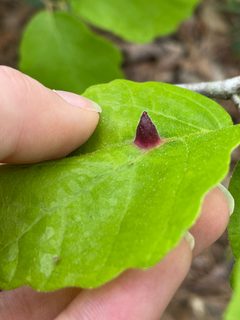
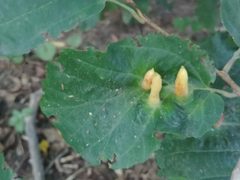
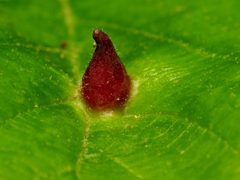
Hormaphidinae exhibits exceptional gall morphological diversity, including: leaf curls (Aleurodaphis), globular pouch galls on flower or leaf buds (Hamamelistes), multiple-cavity flower-like galls (Astegopteryx on Styrax), elongate pouch galls replacing seed (Hamamelistes blackmani on Fothergilla), and woody enclosed galls on tree trunks (Nipponaphis hubeiensis on Sycopsis)—an uncommon in -plant interactions.
Sources and further reading
- BugGuide
- Wikipedia
- iNaturalist taxon
- NCBI Taxonomy
- Catalogue of Life
- Uncategorized | Blog - Part 52
- A new species of gall makers in the aphid genus of plant lice was found in China | Blog
- Diversity of bacteria associated with Hormaphidinae aphids (Hemiptera: Aphididae)
- Review of the East-Asian genus Reticulaphis (Aphididae: Hormaphidinae), with two new species
- Molecular and morphological evidence for the identity of two nominal species of Astegopteryx (Hemiptera, Aphididae, Hormaphidinae)
- Altruistic defenders in a gall-forming aphid of the tribe Hormaphidini (Homoptera, Aphididae, Hormaphidinae) on its primary host
- Figure 14 from: Wang W, Cui Y, Chen X, Bashir NH, Chen H (2021) A new species of the genus Nipponaphis (Aphididae: Hormaphidinae) inducing galls on the trunk of its host plant. Zoologia 38: 1-9. https://doi.org/10.3897/zoologia.38.e60598
- Description of a new species of Hamamelistes forming galls on Fothergilla spp. (Hamamelidaceae) and the generic limits of Hormaphidini (Sternorrhyncha: Aphididae: Hormaphidinae)
- A new species of aphid of the genus Nipponaphis (Hemiptera: Aphididae: Hormaphidinae) from China, inducing galls on the trunk of a witch-hazel (Hamamelidaceae)
- A Review of the Biology of Cerataphidini (Hemiptera, Aphididae, Hormaphidinae), Focusing Mainly on Their Life Cycles, Gall Formation, and Soldiers
- Molecular phylogenetic evidence for paraphyly of Ceratovacuna and Pseudoregma (Hemiptera, Hormaphidinae) reveals late Tertiary radiation
- The life cycle and natural history of the tropical aphidCerataphis fransseni(Homoptera: Aphididae: Hormaphidinae), with reference to the evolution of host alternation in aphids
- Buchnera aphidicola of the birch blister aphid, Hamamelistes betulinus (Horváth, 1896) (Insecta, Hemiptera, Aphididae: Hormaphidinae): molecular characterization, transmission between generations and its geographic significance