
Pemphigus populicaulis
Fitch, 1859
Poplar Leaf-base Gall
Pemphigus populicaulis is a gall-forming that induces distinct galls at the leaf bases of poplar trees. As a member of the Pemphigus, it exhibits the typical of root-gall aphids, alternating between primary (Populus species) and secondary hosts (often roots of herbaceous plants). The species was described by Fitch in 1859 and is widely distributed across North America. It is frequently referenced in historical literature on gall aphids but has been subject to taxonomic confusion with related Pemphigus species.
Pronunciation
How to pronounce Pemphigus populicaulis: //ˈpɛmfɪɡəs ˌpɒpjʊlɪˈkɔːlɪs//
These audio files are automatically generated. While they are not always 100% accurate, they are a good starting point.
Identification
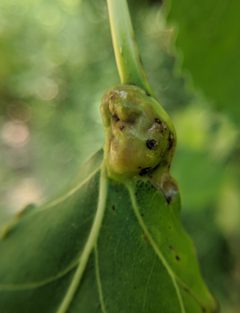
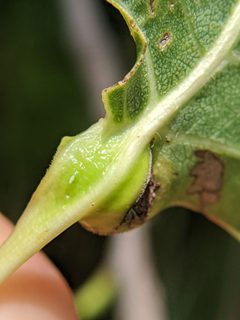
Distinguished from other Pemphigus primarily by gall : P. populicaulis produces galls at the base of poplar leaf petioles, causing the leaf blade to fold or curl downward. This contrasts with P. populitransversus, which forms galls on leaf midribs, and P. betae, which forms spiral leaf galls. Accurate identification often requires examination of gall structure, plant species, and microscopic features of the aphids themselves. The species has been historically confused with P. populitransversus in literature, and misidentifications are common in older records. Molecular methods may be required for definitive separation from closely related .
Images
Appearance
Small, soft-bodied typical of the Aphididae. Like other Pemphigus , it possesses reduced or absent cornicles (siphunculi), a diagnostic feature of the Pemphiginae. The fundatrix (founding stem mother) that initiates the gall is larger and more sclerotized than subsequent . Winged forms () produced during the have distinct wing venation patterns typical of the . Coloration varies by morph and plant stage, ranging from pale yellowish-green to darker green.
Habitat
Primary is on Populus (poplars and cottonwoods), specifically at the leaf bases where galls form. Secondary habitat occurs on roots of various herbaceous plants during the alternate phase of the . The species thrives in riparian zones, floodplains, and other areas where poplars grow. Galls provide a protected microenvironment with regulated humidity and temperature.
Distribution
North America, with records across the United States and Canada. Distribution corresponds to the range of its primary poplar , particularly in eastern and central North America. Specific state and provincial records are scattered in historical literature but comprehensive modern distribution mapping is limited.
Seasonality
Galls initiated in spring by . Fundatrix develops within galls through late spring and early summer. Winged migrants produced in summer disperse to secondary . Return to primary hosts occurs in autumn, with sexual forms producing overwintering eggs. Exact timing varies by latitude and local climate conditions.
Diet
Phloem sap feeder on primary (Populus ) and secondary hosts (roots of various herbaceous plants, exact species poorly documented).
Host Associations
- Populus - primary Galls form at leaf bases
- Populus deltoides - primary
- Populus nigra - primary
Life Cycle
Heteroecious typical of Pemphigus. hatch in spring on primary (Populus), producing fundatrix that initiates gall formation. Multiple parthenogenetic develop within galls through spring and summer. In late summer, winged migrants (alatae) are produced and disperse to secondary hosts (roots of herbaceous plants). Parthenogenetic generations continue on secondary host roots. In autumn, winged return migrants (sexuparae) fly back to primary hosts, producing sexual males and females that mate and deposit overwintering eggs. Some may exhibit truncated or modified cycles under certain conditions.
Behavior
Gall initiation involves chemical manipulation of plant tissue by fundatrix, causing localized plant growth that forms a protective structure. Aphids remain within galls during the gall-dwelling phase, feeding continuously on phloem sap. When gall become crowded or approaches, alatae are produced for . On secondary hosts, aphids feed underground on root phloem, making them cryptic and difficult to detect.
Ecological Role
As a gall-former, modifies plant architecture and resource allocation, though typically without killing host tissues. Galls may provide microhabitats for other organisms including , , and . Serves as host for specialized parasitoid and predators. Root-feeding phase on secondary hosts may contribute to belowground herbivory pressure in plant .
Human Relevance
Minor economic significance. Occasionally mentioned in historical agricultural literature regarding poplar . Has been subject to taxonomic confusion in scientific literature, with implications for accurate pest identification. Not a significant pest of cultivated crops, though related Pemphigus (particularly those on sugar beet) are economically important. Of interest to entomologists studying gall-forming insects and evolution.
Similar Taxa
- Pemphigus populitransversusAlso forms galls on Populus, but on leaf midribs rather than leaf bases; historically confused with P. populicaulis in literature
- Pemphigus betaeForms spiral leaf galls on Populus; distinct gall but similar
- Pemphigus phenaxAnother poplar-galling Pemphigus with overlapping distribution; requires careful gall and morphological examination to distinguish
- Rhopalosiphum rufiabdominaleRoot-feeding frequently misidentified as 'Pemphigus' in online cannabis forums; belongs to different (Aphidinae) and has cornicles, unlike Pemphigus
Misconceptions
The name 'Pemphigus populicaulis' has been incorrectly applied to root problems on cannabis in online forums and informal literature. This is erroneous: P. populicaulis is a poplar-galling with no documented association with Cannabis. The actual root aphid on cannabis is typically Rhopalosiphum rufiabdominale (rice root aphid). This misidentification has propagated through borrowed images and incorrect information in cannabis .
More Details
Taxonomic history
Described by Asa Fitch in 1859, with subsequent taxonomic revisions placing it within the Pemphigus (Pemphigus) subgenus. The has undergone repeated synonymization and resurrection in , reflecting broader challenges in species-level identification within the .
Gall morphology
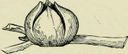
Galls are typically pouch-like or purse-shaped structures formed at the junction of leaf petiole and stem, causing the leaf to assume a drooping posture. Gall size and shape vary with poplar and environmental conditions.