
Pemphigus populitransversus
Riley, 1879
poplar petiole gall aphid, cabbage root aphid
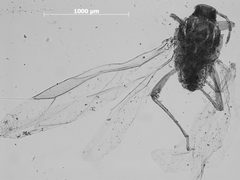
Pemphigus populitransversus is a gall-forming that induces distinctive fleshy galls on the petioles of poplar leaves. The exhibits a complex involving alternation between primary (Populus species) and secondary hosts in the Brassicaceae . On poplars, females induce green or red galls up to 14 mm in diameter at leaf bases, where they lay ; a slit in the gall allows aphid exit. On Brassica hosts, the aphid forms root galls. are small (1.6–2.6 mm) and morphologically distinct from other aphids in lacking abdominal cornicles and having relatively short and legs.
Pronunciation
How to pronounce Pemphigus populitransversus: //ˈpɛmfɪɡəs poʊˌpjuːlɪtrænzˈvɜːrsəs//
These audio files are automatically generated. While they are not always 100% accurate, they are a good starting point.
Identification
Distinguished from other aphids by the combination of: (1) absence of cornicles on the ; (2) relatively short and legs; (3) association with distinctive petiole galls on Populus . The gall —fleshy, smooth, green or red, up to 14 mm diameter with an exit slit at the leaf base—is diagnostic. Similar gall-forming Pemphigus species may be distinguished by gall position and specificity; P. populitransversus specifically forms galls at leaf bases (petioles) rather than on leaf blades or stems. Root gall formation on Brassicaceae hosts provides additional diagnostic context.
Images
Habitat
Primary is Populus-dominated riparian and woodland areas where galls form on black cottonwood, narrowleaf cottonwood, Fremont cottonwood, and aspen. Secondary habitat includes agricultural and wildland settings where Brassicaceae plants (cabbage and relatives) occur, with aphids forming subterranean root galls.
Distribution
Recorded from North America (type locality and primary range); distribution patterns have been analyzed in morphometric studies. GBIF records indicate presence in Belgium and Brazil (Minas Gerais, Paraná, Rio Grande do Sul, Santa Catarina, São Paulo). Azores records (Flores, São Miguel, Santa Maria) suggest introduced or overlooked on islands.
Diet
Phloem-feeding on Populus (primary ) and Brassicaceae (secondary hosts). Specific feeding mechanisms and plant tissue preferences follow the typical style of piercing-sucking, but detailed dietary composition beyond host plant is not documented.
Host Associations
- Populus trichocarpa - primary Black cottonwood; galls induced at leaf bases
- Populus angustifolia - primary Narrowleaf cottonwood
- Populus fremontii - primary Fremont cottonwood
- Populus tremuloides - primary Aspen
- Brassicaceae - secondary Root gall formation; includes cabbage and related
Life Cycle
Complex with alternation. On primary Populus hosts: females induce petiole galls and lay within them; gall contains a slit for exit. On secondary Brassicaceae hosts: forms root galls. The exhibits morph allocation between winged () and wingless () forms, with winged forms presumably mediating host transfer. Detailed seasonal progression and precise number of are not fully documented in available sources.
Behavior
Gall induction is the defining : females chemically and mechanically manipulate poplar leaf petiole tissue to form enclosed feeding chambers. Gall formation includes creation of an exit slit, suggesting programmed structural modification of tissue. Winged morph production allows between primary and secondary hosts.
Ecological Role
As a gall-former, modifies plant architecture and potentially influences leaf physiology and carbon allocation in poplars. Subterranean root galls on secondary hosts may affect root function. Specific impacts ( attraction, nutrient cycling effects) are not documented.
Human Relevance
"cabbage root " indicates potential agricultural significance on Brassicaceae crops, though economic impact is not quantified in available sources. Misidentification risk exists: internet sources have incorrectly attributed cannabis root aphid damage to Pemphigus , when actual damage is caused by Rhopalosiphum rufiabdominale (rice root aphid).
Similar Taxa
- Pemphigus speciesOther members of form galls on Populus, but differ in gall position (leaf blade vs. petiole) and specificity. P. populitransversus is specifically associated with petiole galls.
- Rhopalosiphum rufiabdominaleBoth form root galls and have been confused in agricultural contexts, particularly regarding cannabis. R. rufiabdominale is a rice root aphid with different range and lacks the aerial gall phase on poplars.
Misconceptions
Widely misidentified in internet forums and agricultural reporting regarding "root aphids" on cannabis. Pemphigus populitransversus has been incorrectly implicated in cannabis root damage; actual damage is caused by Rhopalosiphum rufiabdominale. This confusion has propagated through borrowed images and incorrect biological information online.
More Details
Morphological plasticity
A 1979 study examined allocation methods and morphometrics of winged versus wingless morphs, indicating significant phenotypic plasticity in response to environmental cues.
Taxonomic status note
Catalogue of Life lists status as "ambiguous synonym" but GBIF and NCBI recognize as accepted; this may reflect ongoing taxonomic refinement within Pemphigus.