
Pemphigus betae
Doane, 1900
sugarbeet root aphid, sugar-beet root-louse
Pemphigus betae is a gall-forming with a complex involving alternation between cottonwood trees (Populus angustifolia, P. balsamifera) and sugar beet roots. Stem mothers emerge in spring to form galls on poplar leaves, producing up to 300 progeny per gall. Winged migrants disperse to Chenopodiaceae roots for summer feeding, causing significant agricultural damage. The exhibits clonal variation in host-alternation propensity, with some lineages remaining on roots year-round. Molecular studies reveal cryptic sympatric diversity, with morphologically indistinguishable galls formed by P. betae, P. populivenae, and a third undetermined species.
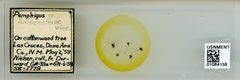
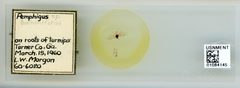
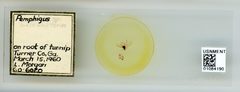
Pronunciation
How to pronounce Pemphigus betae: //ˈpɛmfɪɡəs ˈbiːtaɪ//
These audio files are automatically generated. While they are not always 100% accurate, they are a good starting point.
Identification
Distinguished from other Pemphigus by gall formation specifically on Populus angustifolia and P. balsamifera leaves, though molecular evidence indicates gall is unreliable for species identification. Sympatric with P. populivenae and a third cryptic species forming morphologically identical galls on the same trees. Requires molecular markers (COI barcode, nuclear microsatellites) for definitive identification. Root-feeding stage on Chenopodiaceae distinguishes it from non--alternating Pemphigus species.
Images
Appearance
Small with body length 1.9–2.4 mm. Globular, soft-bodied with bulbous shape. Pale white-yellow coloration. Possesses and paired abdominal siphunculi. Both winged () and wingless () forms occur. Size likened to a pinhead.
Habitat
Primary : leaf galls on Populus angustifolia and P. balsamifera trees during spring and autumn. Secondary habitat: root zone of sugar beet (Beta vulgaris), table beet, Swiss chard, and other Chenopodiaceae during summer. most severe under dry soil conditions or reduced irrigation. In Alberta, found in southern regions with documented in Lethbridge-Monarch area.
Distribution
Native to North America; introduced to Europe. In North America: documented in Texas, California, Michigan, Minnesota, and Alberta, Canada. European records limited to few sites with potential for rapid range expansion. In Utah, occurs in canyon showing clonal variation in strategies.
Seasonality
Fundatrix hatches late April to early May in southern Alberta. Fundatrigeniae migrate to sugar beet roots late June to mid-August. Sexuparae return to Populus early September to late October. Peak severity July and late August. Overwinters as on Populus bark or as alienicolae in soil.
Diet
Phloem sap from Populus angustifolia and P. balsamifera leaves (within galls) and from roots of Beta vulgaris (sugar beet), table beet, Swiss chard, and other Chenopodiaceae. Galls act as physiological sinks, intercepting 14C-labeled resources from leaf midveins and neighboring leaves—basal galls obtain 29% of carbon from adjacent leaves versus 7% for galls.
Host Associations
- Populus angustifolia - primary Narrowleaf cottonwood; gall formation site for stem mothers
- Populus balsamifera - primary Balsam poplar; alternative gall in Alberta
- Beta vulgaris - secondary Sugar beet; summer root-feeding causes agricultural damage
- Beta vulgaris subsp. vulgaris - secondary Table beet
- Beta vulgaris subsp. cicla - secondary Swiss chard
Life Cycle
Heteroecious with obligate alternation (though clonal variation exists): (1) on Populus bark hatches in spring; (2) Fundatrix (stem mother) forms gall on emerging leaf, reproduces parthenogenetically producing up to 300 fundatrigeniae; (3) fundatrigeniae migrate to Chenopodiaceae roots late June–mid-August, producing alienicolae; (4) Multiple parthenogenetic on roots through summer—20 aphids can produce 9,000 in 6 weeks at 27°C; (5) Sexuparae produced in autumn migrate back to Populus September–October; (6) Sexual males and oviparae mate, each fertilized female lays single overwintering egg on bark. Egg requires low temperature exposure to terminate . Some exhibit simplified with year-round root residence.
Behavior
Stem mothers exhibit intense territorial competition for optimal gall sites. Large leaves near the stem base are colonized first; basal position yields 49–65% more offspring than settlement. Competitors engage in prolonged kicking and shoving contests (rear-to-rear, pushing with hind legs) lasting several days. Losers settle distally or become 'floaters' searching for unoccupied leaves. Ideal free distribution observed: some stem mothers settle alone on smaller leaves rather than share larger leaves, resulting in equivalent reproductive success. Probing activity with stylets induces gall formation; extent of probing correlates with gall size and reproductive success, and may allow assessment of future leaf size through chemical cues. migrants preferentially colonize larger Populus trees using crown size as cue, ignoring leaf size. Autumn migrants are short-lived (12–48 hours). Infected individuals climb to plant surface and cling to leaves before death (behavioral manipulation by Entomophthora aphidis).
Ecological Role
Gall-former that manipulates plant resource allocation, creating physiological sinks that divert nutrients from leaf transport streams and neighboring leaves. Agricultural pest causing yield loss and sucrose content reduction in sugar beet. Serves as host for fungus Entomophthora aphidis and including Anthocoris antevolens, syrphid flies (Sphaerophoria bigelowi, Leucopis pemphigae, Trichopsomyia glabra), and Scymnus sp. coccinellids. Genetic studies indicate it exerts selection pressure on Populus angustifolia resistance genes (NIN1, C/VIF1).
Human Relevance
Major agricultural pest of sugar beet crops in North America. Economic impact documented in Minnesota (1990–1991) through sucrose content reduction and yield loss; severity increased in drought years or under low irrigation. Management difficult: crop and foliar generally ineffective. Effective chemical controls include Knox Out 2FM and Counter 15G (registration varies by state). Integrated management requires destruction of infested plant material, weed control, equipment cleaning, and 3-year field rotation. via fungal or natural under investigation but not yet fully effective. Water stress avoidance recommended to reduce yield loss.
Similar Taxa
- Pemphigus populivenaeForms morphologically indistinguishable galls on same Populus ; sympatric in Alberta; requires molecular markers for differentiation
- Pemphigus species (undetermined third taxon)Third cryptic sympatric in Alberta forming identical galls; molecular evidence only distinguishing feature
- Rhopalosiphum rufiabdominaleAlso called 'root ' and colonizes plant roots, but belongs to different (Aphidinae vs. Pemphiginae); does not form galls on Populus; often misidentified in online sources discussing 'root aphids'
Misconceptions
Widely misidentified in internet discussions of 'root aphids' on cannabis and other crops, where images and of Pemphigus betae are often conflated with Rhopalosiphum rufiabdominale (rice root aphid) or other root-feeding . Gall has been traditionally used to identify Pemphigus species but is unreliable for distinguishing P. betae, P. populivenae, and the third sympatric . The 'sugarbeet root ' incorrectly implies exclusive association with sugar beet, when the species is equally dependent on Populus trees for completion of its .
More Details
Genetic and clonal variation
Utah canyon show significant clonal variation in -alternation propensity. from lineages that alternated to cottonwood in the previous year produce more migrants and have lower average than clones from lineages that remained on roots. Host alternation loss can occur through genetic change, environmental change, or both.
Temperature effects on reproduction
Optimal soil temperature for approximately 27°C; reproduction low below 15°C; lethal exposure to 30°C for 6 weeks. These thermal limits influence seasonal activity patterns and geographic distribution.
Sympatric molecular diversity
Alberta contain three (P. betae, P. populivenae, undetermined ) occurring sympatrically on same trees, often same leaves, with indistinguishable gall . This cryptic diversity suggests that species-level identifications based on gall characteristics alone are unreliable for this group.
Sources and further reading
- BugGuide
- Wikipedia
- GBIF taxonomy match
- iNaturalist taxon
- NCBI Taxonomy
- Catalogue of Life
- Rice Root Aphid: An Insect Surprise on Indoor-Grown Cannabis
- The Life History of the Sugar-Beet Root-Louse (Pemphigus Betae Doane)
- Molecular evidence for sympatric taxa withinPemphigus betae(Hemiptera: Aphididae: Eriosomatinae)
- Ecology and Management ofPemphigus betae(Hemiptera: Aphididae) in Sugar Beet
- Sugar-Beet Root Aphid, Pemphigus betae Doane (Homoptera: Aphididae), in Southern Alberta
- Phenotype Fixation and Genotypic Diversity in the Complex Life Cycle of the Aphid Pemphigus betae
- Genotypic variation in propensity for host alternation within a population of Pemphigus betae (Homoptera: Aphididae)
- Notes on Behaviour of Pemphigus betae Doane (Homoptera: Aphididae) Infected with Entomophthora aphidis Hoffm.
- PHENOTYPE FIXATION AND GENOTYPIC DIVERSITY IN THE COMPLEX LIFE CYCLE OF THE APHID PEMPHIGUS BETAE
- Genetic variation in NIN1 and C/VIF1 genes is significantly associated with Populus angustifolia resistance to a galling herbivore, Pemphigus betae