
Mordwilkoja vagabunda
(Walsh, 1863)
Poplar Vagabond Aphid
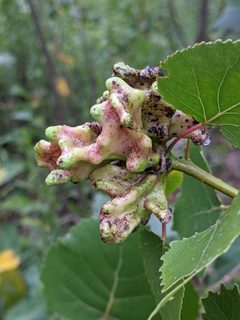
A gall-forming that induces distinctive galls on Populus deltoides (eastern cottonwood). Nymphs exhibit anti- including synchronized rhythmic movements and active defense against pyralid larvae using legs and rostrums. Unlike some related aphids, defensive nymphs include alatoid forms rather than specialized first-instar soldiers. The has a complex with alternation between primary and secondary .
Pronunciation
How to pronounce Mordwilkoja vagabunda: /mɔrdˈwɪlkoʊja væɡəˈbʌndə/
These audio files are automatically generated. While they are not always 100% accurate, they are a good starting point.
Images
Habitat
Forms galls on Populus deltoides (eastern cottonwood). Galls provide enclosed feeding and breeding chambers within leaf or petiole tissue.
Distribution
Eastern North America; documented from Ithaca, New York and Vermont, USA.
Seasonality
Gall formation and nymph activity observed in July in Ithaca, NY.
Diet
Phloem sap of Populus deltoides.
Host Associations
- Populus deltoides - primary Galls formed on this ; site of and production
- pyralid moth larvae - Attacked nymphs in experimental encounters; not a true
Life Cycle
Complex involving alternation between primary (Populus deltoides, where galls form) and secondary host. on primary host produces . Parthenogenetic occurs during gall phase and on secondary host. Nymphs of all instars present in galls; alatoid nymphs observed participating in defense.
Behavior
Nymphs defend against by clawing with legs and pressing rostrums against attackers, possibly to pierce . Synchronized rhythmic burst movements occur among nearby aphids, hypothesized as collective anti-predator defense comparable to Aphis nerii. Alatoid nymphs participate in defense rather than only specialized first-instar soldiers.
Ecological Role
Gall-former on Populus deltoides; modifies plant tissue to create protected feeding chambers. Serves as prey for pyralid larvae and potentially other .
Similar Taxa
- Pemphigus speciesRelated gall-forming aphids with specialized first-instar soldier for defense; M. vagabunda differs in using alatoid nymphs for defense
- Aphis neriiExhibits similar collective twitching and kicking anti- responses; comparison made in behavioral studies
Sources and further reading
- BugGuide
- GBIF taxonomy match
- iNaturalist taxon
- NCBI Taxonomy
- Catalogue of Life
- Bug Eric: Fly Day Friday: Cluster Flies
- Bug Eric: January 2013
- Life History and Gall Development of Mordwilkoja vagabunda (Homoptera: Aphidae) on Populus deltoides1
- First record of antipredator behavior in the gall‐forming aphid Mordwilkoja vagabunda
- First record of anti-predator behavior in the gall-forming aphid Mordwilkoja vagabunda
- Life History and Gall Development of Mordwilkoja vagabunda (Homoptera: Aphidae) on Populus deltoides. Part II—Gall Development1