
Kaltenbachiella ulmifusa
(Walsh & Riley, 1869)
Slippery Elm Gall Aphid
Kaltenbachiella ulmifusa, commonly known as the Slippery Elm Gall , is a gall-forming aphid in the Aphididae. It induces distinctive galls on elm trees (Ulmus spp.), particularly on slippery elm (Ulmus rubra). The species is native to North America and has been documented primarily in the eastern and central United States. Like other members of the Eriosomatinae, it exhibits a complex involving alternation.
Pronunciation
How to pronounce Kaltenbachiella ulmifusa: /kæl.tɛnˈbæ.kiˈɛ.lə ˌʌl.mɪˈfjuː.sə/
These audio files are automatically generated. While they are not always 100% accurate, they are a good starting point.
Identification
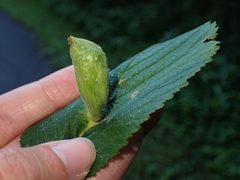
Best identified by the galls formed on elm leaves—pouch-like or rolled-leaf galls that enclose colonies of aphids. The galls are green when fresh, becoming brown with age. Direct identification of aphids requires microscopic examination of morphological characters including antennal segments, siphunculi structure, and cauda shape. Distinguished from other elm gall aphids by gall and specificity; differs from Tetraneura and other Eriosomatinae by the specific gall form on Ulmus rubra.
Images
Appearance
are small, soft-bodied aphids with pear-shaped bodies typical of the Aphididae. Wingless forms (apterae) are pale green to yellowish. Winged forms (alatae) have dark thoracic markings and transparent wings with characteristic venation. The is most readily identified by the galls it produces rather than by direct examination of the aphids themselves.
Habitat
Deciduous forests, riparian woodlands, and urban areas where elm trees occur. Specifically associated with slippery elm (Ulmus rubra) and occasionally other elm . Requires mature elm trees for gall formation.
Distribution
Native to North America. Documented from the eastern and central United States, with records extending from the Great Plains eastward to the Atlantic coast. Distribution corresponds closely with the range of its primary , Ulmus rubra.
Seasonality
Galls are most visible from late spring through summer (May-August). Aphids emerge from galls in late summer to early fall to migrate to secondary . occurs as on elm twigs.
Diet
Phloem sap feeder; extracts nutrients from vascular tissues of plants. Primary host is slippery elm (Ulmus rubra); secondary host relationships are not fully documented but likely involve roots of grasses or other plants as in related .
Host Associations
- Ulmus rubra - primary Forms galls on leaves; required for and gall formation
- Ulmus americana - occasional Has been observed on American elm, though less commonly
Life Cycle
Complex with alternation (heteroecy). and gall formation occur on primary host (elm). Fundatrices hatch from in spring and induce leaf galls. Multiple develop within galls through summer. In late summer, winged migrants (alatae) emerge and fly to secondary hosts (likely grass roots, though not confirmed for this ). After several parthenogenetic generations on secondary hosts, winged return migrants fly back to elm in autumn, where sexual forms are produced, mate, and deposit overwintering eggs.
Behavior
Forms dense colonies within protective leaf galls. Gall formation involves chemical manipulation of plant tissue by feeding aphids. When disturbed, colonies may produce . Late-season migrants exhibit phototactic during .
Ecological Role
Acts as a gall-inducing herbivore that modifies plant growth. Provides food source for and including lady beetles (Coccinellidae), lacewings (Chrysopidae), and parasitic . Galls may serve as microhabitats for other . Contributes to nutrient cycling through honeydew production and subsequent growth.
Human Relevance
Minor economic significance; galls cause cosmetic damage to ornamental elms but rarely threaten tree health. Occasionally used in ecological studies of gall-forming insects and plant-insect interactions. The references its association with slippery elm, a tree used historically for medicinal bark.
Similar Taxa
- Tetraneura ulmiAlso forms galls on elm leaves; distinguished by gall (T. ulmi produces more globular, less folded galls) and by microscopic examination of morphology
- Colopha ulmicolaAnother elm-feeding Eriosomatinae; differs in gall structure and preferences, typically forming different gall types on American elm
- Kaltenbachiella japonicaCongeneric native to Asia; distinguished by geographic range and subtle morphological differences, though not overlapping in distribution
More Details
Gall Morphology
The galls of K. ulmifusa are among the most distinctive of North American elm galls, formed by the folding or rolling of leaf margins to create a pouch-like structure that encloses the colony.
Taxonomic History
Originally described by Walsh and Riley in 1869, this has remained in the Kaltenbachiella following taxonomic revisions of the Eriosomatinae. The genus is named after German entomologist Johann Heinrich Kaltenbach.