
Kaltenbachiella
Schouteden, 1906
Species Guides
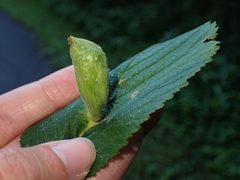
1- Kaltenbachiella ulmifusa(Slippery Elm Gall Aphid)
Kaltenbachiella is a of gall-forming aphids in the Aphididae, Eriosomatinae. The genus was established by Schouteden in 1906 and contains at least three described . Members of this genus are known for inducing closed galls on plants and exhibit fine- genetic to individual host tree phenologies. The best-studied species, Kaltenbachiella japonica, demonstrates specialized with elm trees.
Pronunciation
How to pronounce Kaltenbachiella: //kæl.tənˈbæki.ə.lə//
These audio files are automatically generated. While they are not always 100% accurate, they are a good starting point.
Images
Habitat
Associated with deciduous trees, particularly elms (Ulmus ). Gall formation occurs on leaf midribs.
Distribution
Distribution records from Denmark, Norway, and Sweden. -level distributions vary: Kaltenbachiella japonica occurs in Japan.
Seasonality
Activity synchronized with tree budburst . hatching timed to coincide with leaf .
Diet
Phloem-feeding on trees. Kaltenbachiella japonica feeds on Ulmus davidiana var. japonica.
Host Associations
- Ulmus davidiana var. japonica - Primary for Kaltenbachiella japonica; gall formation on leaf midribs
Life Cycle
First-instar fundatrices induce closed galls on leaf midribs. Sexuparae emerge from galls to produce sexual morphs. Leaves bearing multiple galls may wither before sexuparae .
Behavior
Foundatrices select gall sites based on leaf vigor, as indicated by lateral- length. Multiple galls often induced on a single leaf. Gall-site selection represents a compromise between optimal positioning for offspring production and synchrony with -plant leaf .
More Details
Genetic Adaptation
of Kaltenbachiella japonica show significant genetic differentiation associated with individual trees, with -hatching time correlated to budburst of respective host trees. This represents fine- local without maternal effects on hatching timing.
Sources and further reading
- BugGuide
- Wikipedia
- GBIF taxonomy match
- iNaturalist taxon
- NCBI Taxonomy
- Catalogue of Life
- Genetic differentiation as a result of adaptation to the phenologies of individual host trees in the galling aphid Kaltenbachiella japonica
- Gall distribution as a compromise between the optimal gall-site selection and the synchrony to host-plant phenology in the aphid Kaltenbachiella japonica