
Hyperomyzus
Börner, 1933
Currant-Daisy Aphids
Species Guides
2- Hyperomyzus lactucae(Sowthistle Aphid)
- Hyperomyzus pallidus(Gooseberry-Sowthistle Aphid)
Hyperomyzus is a of aphids in the Aphididae, established by Börner in 1933. The genus comprises more than 20 described , commonly known as Currant-Daisy Aphids. The best-studied species, Hyperomyzus lactucae (the sowthistle ), is a significant agricultural pest and plant virus . Members of this genus exhibit typical aphid characteristics including phloem-feeding habits and complex involving both sexual and .
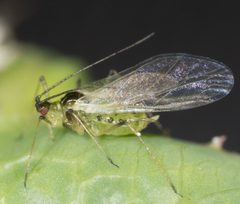
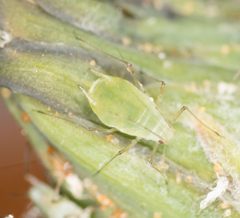
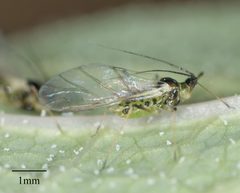
Pronunciation
How to pronounce Hyperomyzus: //haɪˌpɛroʊˈmaɪzəs//
These audio files are automatically generated. While they are not always 100% accurate, they are a good starting point.
Images
Habitat
Associated with herbaceous plants; H. lactucae specifically feeds on Sonchus oleraceus (sowthistle) and related Asteraceae. H. lactucae has been observed on black currants (Ribes nigrum) in agricultural settings.
Distribution
-level distribution includes records from Denmark, Norway, and Sweden. H. lactucae has been introduced to Australia as a pest .
Diet
Phloem-feeding; H. lactucae feeds primarily on Sonchus oleraceus (sowthistle), with 92.5% of feeding sites located in phloem tissue. Also feeds on lettuce and has been observed on black currants.
Host Associations
- Sonchus oleraceus - primary plantNatural wild plant ; 92.5% of feeding sites terminate in phloem tissue
- Lactuca sativa - crop Lettuce; H. lactucae is a principal of lettuce necrotic yellows virus
- Ribes nigrum - agricultural Black currant; subject of control studies using plant growth regulators
Life Cycle
H. lactucae produces both (wingless) and (winged) virginoparae. Development time, , and vary with temperature and . At daily mean temperatures of 12.5–24°C, development speed and reproductive rate increase with temperature, while lifespan and total fecundity decrease. Alatae generally have longer development times and lower reproductive rates than apterae under identical conditions. Conditions experienced by embryos within their mother influence subsequent survival and development.
Behavior
H. lactucae exhibits temperature-dependent in wing development. Parasitization by Aphidius sonchi affects wing development in potentially alatiform nymphs, with effects appearing sooner than effects on molting. The extent of wing development in parasitized nymphs depends entirely on age at time of attack.
Ecological Role
H. lactucae is a of lettuce necrotic yellows virus and sowthistle yellow virus. of plants with sowthistle yellow vein virus reduces , , and survival, indicating a negative feedback loop. Serves as host for Aphidius sonchi, which has been used as a agent.
Human Relevance
H. lactucae is an agricultural pest and virus of economic importance. It transmits lettuce necrotic yellows virus to lettuce crops and has been targeted with plant growth regulators (chlormequat chloride) for control on black currants. Aphidius sonchi has been introduced to Australia specifically as a agent against this .
More Details
Parasitoid Interactions
Aphidius sonchi, a hymenopterous , oviposits in all nymphal instars and both and of H. lactucae. Only one is laid per ovipositor insertion. Superparasitization occurs but only one per survives to adulthood. Parasitoid (size and ) depends on size during the parasite's destructive feeding phase, not host stage at egg reception.
Temperature Sensitivity
H. lactucae has a notional development threshold of approximately 2°C. The is positively correlated with temperature on a daily basis, but inversely related when measured on physiological time. Tolerable temperature limits vary with the pattern and amplitude of temperature fluctuations.
Sources and further reading
- BugGuide
- Wikipedia
- GBIF taxonomy match
- iNaturalist taxon
- NCBI Taxonomy
- Catalogue of Life
- Reduction of excretion, reproduction, and survival in Hyperomyzus lactucae fed on plants infected with isolates of sowthistle yellow vein virus
- The Feeding Sites in Songhus Olerageus of Hyperomyzus Lagtugae, the Aphid Vector of Lettuce Necrotic Yellows Virus
- The influence of temperature and photoperiod on the development, survival and reproduction of the sowthistle aphid, Hyperomyzus lactucae
- The influence of temperature and photoperiod on the development, survival and reproduction of the sowthistle aphid, Hyperomyzus lactucae
- Use of the plant growth regulator chlormequat chloride to control the aphid Hyperomyzus lactucae on black currants
- Development, adult size and fecundity of Aphidius sonchi reared in two instars of its aphid host, Hyperomyzus lactucae
- Studies on the biology of Aphidius sonchi Marshall (Hymenoptera: Aphidiidae), a parasite of the sowthistle aphid, Hyperomyzus lactucae (L.) (Hemiptera: Aphididae)
- Effect of host age at parasitization by Aphidius sonchi on the development, survival, and reproduction of the sowthistle aphid, Hyperomyzus lactucae