
Ceruraphis viburnicola
(Gillette, 1909)
Snowball Aphid
An found in spring and autumn on Viburnum in North America. It induces curled leaf galls on primary hosts. The secondary hosts remained unrecorded as of 1960. The female was first described in a 1960 Canadian Entomologist paper.
Pronunciation
How to pronounce Ceruraphis viburnicola: /sɛˌruːrəˈfɪs vaɪbɜːnɪˈkɒlə/
These audio files are automatically generated. While they are not always 100% accurate, they are a good starting point.
Identification
Distinguished from Ceruraphis eriophori by association: C. viburnicola occurs on Viburnum opulus var. roseum and V. trilobum, while C. eriophori occurs on V. and V. opulus. The female was described by Richards (1960) to aid separation from .
Images
Habitat
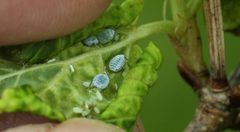
Curled leaves of Viburnum , where it forms leaf galls.
Distribution
Recorded from New Brunswick and Colorado, USA.
Seasonality
Active in spring and autumn on primary .
Diet
Phloem sap of Viburnum . Secondary unknown.
Host Associations
- Viburnum opulus var. roseum - primary curled leaf galls
- Viburnum trilobum - primary curled leaf galls
- Viburnum opulus var. sterile - primary synonym of var. roseum
Life Cycle
with spring and autumn on primary Viburnum . Secondary host plants unrecorded. Reproduces via viviparity; female described.
Behavior
Induces leaf curling on plants, forming sheltered feeding sites within curled leaves.
Ecological Role
Herbivore and gall-former on Viburnum; specific interactions beyond damage unrecorded.
Human Relevance
Minor ornamental pest on snowball bush (Viburnum opulus var. roseum). No significant economic impact documented.
Similar Taxa
- Ceruraphis eriophoriOverlaps in distribution and shares Viburnum opulus as , but C. eriophori uses V. and V. opulus (not var. roseum), and has recorded secondary hosts (Carex, Eriophorum, Luzula, Typha, Cyperus) whereas C. viburnicola secondary hosts remain unknown.
- Neoceruraphis viburnicolaTaxonomic synonym; same under alternate placement.