
Ceruraphis eriophori
(Walker, 1848)
Wayfaring Tree-sedge Aphid
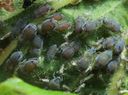
Ceruraphis eriophori is an with a heteroecous involving alternation between Viburnum species (primary hosts) and sedges or related plants (secondary hosts). In North America, it has been collected from curled leaves of Viburnum and V. opulus in New Brunswick, and from V. opulus var. roseum in Colorado. The species also occurs in Europe, where secondary hosts include Carex, Eriophorum, Luzula, and Typha; in North America, Cyperus virens is the only reported secondary host. Activity peaks in spring and autumn on primary hosts.


Pronunciation
How to pronounce Ceruraphis eriophori: //sɛˈrʊr.ə.fɪs ɛˌriː.oʊˈfɔː.raɪ//
These audio files are automatically generated. While they are not always 100% accurate, they are a good starting point.
Images
Habitat
Found on curled leaves of Viburnum during spring and autumn; secondary include wetland and grassland environments where sedges (Carex, Cyperus), cottongrass (Eriophorum), woodrush (Luzula), and cattail (Typha) occur.
Distribution
North America: New Brunswick, Colorado; Europe: Belgium, Denmark, Norway, Sweden.
Seasonality
Active on primary Viburnum in spring and autumn; specific timing on secondary hosts not documented.
Diet
Phloem-feeding on Viburnum (primary ); secondary host feeding recorded on Cyperus virens in North America and on Carex, Eriophorum, Luzula, and Typha species in Europe.
Host Associations
- Viburnum lantana - primary Collected from curled leaves in New Brunswick
- Viburnum opulus - primary Collected from curled leaves in New Brunswick
- Viburnum opulus var. roseum - primary Recorded in Colorado; previously reported as V. opulus var. sterile
- Cyperus virens - secondary Only North American secondary reported
- Carex - secondary European ; -level record
- Eriophorum - secondary European ; -level record
- Luzula - secondary European ; -level record
- Typha - secondary European ; -level record
Life Cycle
Heteroecous with alternation between Viburnum (primary) and sedges or related plants (secondary); specific morphs and sequence of not detailed in available sources.
Behavior
Induces leaf curling on primary Viburnum .
Ecological Role
Phloem-feeding herbivore; specific ecological interactions not documented.
Similar Taxa
- Neoceruraphis viburnicolaSympatric on Viburnum opulus; distinguished by associations and morphological features not detailed in available sources. N. viburnicola has not been recorded from secondary hosts, unlike C. eriophori.