
Scolopostethus
Fieber, 1861
dirt-colored seed bugs
Species Guides
6- Scolopostethus atlanticus(dirt-colored seed bug)
- Scolopostethus diffidens(dirt-colored seed bug)
- Scolopostethus pacificus
- Scolopostethus pictus(dirt-colored seed bug)
- Scolopostethus thomsoni(Thomson's groundbug)
- Scolopostethus tropicus(dirt-colored seed bug)
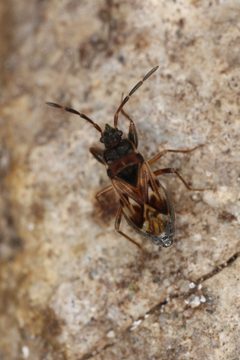
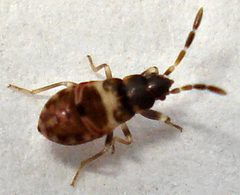
Scolopostethus is a of dirt-colored seed bugs comprising more than 30 described in the Rhyparochromidae. Species occupy diverse including areas, weedy lawns, and -associated environments. Some species are myrmecophilous, living near ant nests through chemical defense strategies rather than chemical mimicry. The genus has a Palearctic origin with at least one species, S. affinis, recently established in North America.
Pronunciation
How to pronounce Scolopostethus: //skɒləpəˈstiːθəs//
These audio files are automatically generated. While they are not always 100% accurate, they are a good starting point.
Images
Habitat
areas and weedy lawns; associated with nettles (Urtica dioica) and various weeds including dandelion (Taraxacum), knapweed (Centaurea), burdock (Arctium), and lamb's quarters (Chenopodium album); some occur near nests of the velvety tree ant (Liometopum occidentale)
Distribution
Native to Palearctic region (Europe including Russia, Asia); Central Asia (Kazakhstan, Uzbekistan, Turkmenistan, Kyrgyzstan, Tajikistan); China; Scandinavia (Denmark, Norway, Sweden); at least one (S. affinis) established in North America with confirmed records from Montreal, Quebec
Diet
Seeds are the principal food item; seeds of stinging nettle (Urtica dioica) have been observed to produce the most productive growth curve in rearing experiments; some can survive on larvae but show minimal growth
Host Associations
- Urtica dioica - primary plant; seeds are principal food sourcestinging nettle
- Taraxacum sp. - associated weeddandelion
- Centaurea sp. - associated weedknapweed
- Arctium sp. - associated weedburdock
- Chenopodium album - associated weedlamb's quarters
- Liometopum occidentale - myrmecophilous association; lives near nests but does not feed on velvety tree ant; S. pacificus uses chemical weaponry for defense against this
Life Cycle
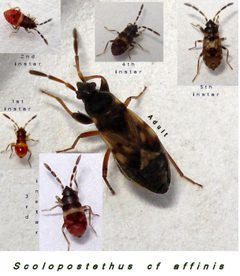
Five stages; single per year or possibly double-brooded with long oviposition season; overwinters in nettle litter or leaf litter near nettles; late-instar nymphs abundant in late September in Quebec
Behavior
Some release a cocktail of volatile compounds from metathoracic glands that moderates encounters with aggressive ants; defensive function of gland exudates confirmed via feeding trials; does not use cuticular hydrocarbon insignificance or mimicry for association; usually brachypterous but forms sometimes present
Ecological Role
Seed feeding on weed seeds; may occupy uncontested in introduced ranges; no known deleterious effects on crops
Human Relevance
S. affinis has been introduced to North America and is established in Quebec; may be a welcome addition to environments due to propensity for feeding on seeds of plants regarded as weeds; adapted to human-modified environments
Similar Taxa
- Other Scolopostethus speciesS. affinis distinguished from Nearctic by male mesosternal processes and female mesosternal , and by antennal coloration; stages of S. affinis cannot be separated from S. thomsoni
- Other RhyparochromidaeMembers of Scolopostethus are distinguished within Drymini by -level morphological characters as detailed in taxonomic keys
Sources and further reading
- BugGuide
- Wikipedia
- GBIF taxonomy match
- iNaturalist taxon
- NCBI Taxonomy
- Catalogue of Life
- Scolopostethus affinis (Schilling) (Hemiptera, Heteroptera, Rhyparochromidae, Drymini): a new alien established in North America
- Using weapons instead of perfume – chemical association strategies of the myrmecophilous bug Scolopostethus pacificus (Rhyparochromidae)
- Review of the genus Scolopostethus Fieber, 1860 (Hemiptera: Heteroptera: Rhyparochromidae) from Central Asia with description of a new species