
Drymini
Stål, 1872
dirt-colored seed bugs
Genus Guides
7- Appolonius
- Drymus
- Eremocoris(dirt-colored seed bugs)
- Gastrodes(dirt-colored seed bugs)
- Scolopostethus(dirt-colored seed bugs)
- Thylochromus(dirt-colored seed bugs)
- Togodolentus
Drymini is a tribe of seed bugs within the Rhyparochrominae of the Rhyparochromidae (Hemiptera: Heteroptera). The tribe comprises more than 50 and over 300 described , distributed across the Holarctic, Oriental, Afrotropical, and Neotropical regions. Members are generally small to medium-sized seed bugs with diverse associations ranging from rainforest to environments. The tribe includes economically relevant genera such as Scolopostethus, some species of which have been introduced to new regions through human activity.
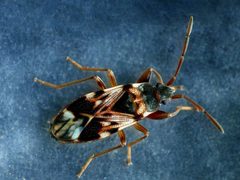
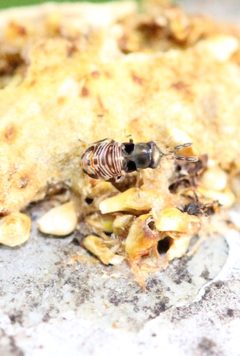
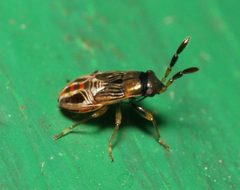
Pronunciation
How to pronounce Drymini: //ˈdrɪmɪnaɪ//
These audio files are automatically generated. While they are not always 100% accurate, they are a good starting point.
Identification
Identification to tribe level requires examination of male genitalia and wing venation characteristics typical of Rhyparochrominae. Within Drymini, are distinguished by combinations of antennal segment proportions, pronotal shape, and male genitalic structures. -level identification typically requires detailed examination of the parameres and . Some genera exhibit wing (brachypterous and forms), which can complicate field identification.
Images
Habitat
vary widely by and . Scolopostethus species occupy areas, weedy lawns, and nettle stands. Megadrymus species occur in subtropical and tropical wet and dry rainforest in Australia. Malgadrymus is to Madagascar. Grossander species inhabit the Oriental Region including New Guinea and mainland Southeast Asia. Latidrymus species are found in India, Thailand, and Laos.
Distribution
Widespread across multiple biogeographic regions: Holarctic (Europe, Asia, North America), Oriental (India, Thailand, Laos, Malaysia, Indonesia, Burma), Afrotropical (Madagascar, Republic of the Congo), Australian (eastern and northern Australia), and Neotropical (Mexico). Some have been introduced outside native ranges; Scolopostethus affinis is established in Quebec, Canada.
Diet
Seed is the primary feeding strategy documented for studied . Scolopostethus affinis feeds principally on seeds, with Urtica dioica (stinging nettle) seeds supporting optimal larval development. The species can survive on larvae but shows minimal growth on this diet. Other recorded plants include Taraxacum, Centaurea, Arctium, and Chenopodium album.
Life Cycle
Development includes and five nymphal instars. Scolopostethus affinis is either single-brooded with an extended oviposition season or double-brooded. occurs in nettle litter or leaf litter near plants. stages of some cannot be reliably separated morphologically.
Behavior
Scolopostethus affinis exhibits wing with both brachypterous (short-winged) and (long-winged) forms present in ; males show higher frequency of brachyptery than females. The is and adapted to human-modified environments. Hybridization between Scolopostethus species is not successful.
Ecological Role
Some may function as agents for weeds by feeding on seeds of plants including nettles, dandelions, knapweeds, burdocks, and lamb's quarters. No deleterious effects on crops have been documented. Introduced species may occupy uncontested in recipient .
Human Relevance
Scolopostethus affinis has been introduced to North America and is established in Montreal, Quebec, representing a new record for the continent. The habits of some species result in association with human-modified landscapes. No significant agricultural pest status has been documented.
Sources and further reading
- BugGuide
- Wikipedia
- iNaturalist taxon
- Catalogue of Life
- New species of Grossander Slater, 1976 (Hemiptera: Heteroptera: Rhyparochromidae: Drymini) from the Oriental Region
- Latidrymus, a new genus of Drymini from the Oriental Region (Hemiptera: Heteroptera: Rhyparochromidae)
- Scolopostethus affinis (Schilling) (Hemiptera, Heteroptera, Rhyparochromidae, Drymini): a new alien established in North America
- Systematics and biology of the Australian seed bug genus Megadrymus Gross (Insecta : Heteroptera : Rhyparochromidae : Drymini)
- Drymini of Madagascar, with description of a new genus and three new species (Hemiptera: Heteroptera: Rhyparochromidae)
- Eremocoris juquilianus a new bug species from the mountains in Oaxaca, Mexico (Hemiptera: Rhyparochromidae: Drymini): with description of the immature stages