
Oncopeltus guttaloides
Slater, 1964
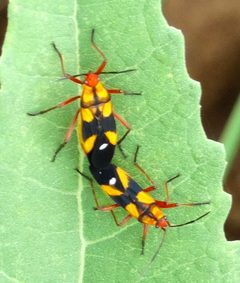
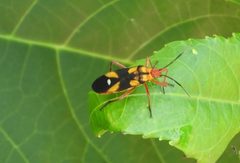
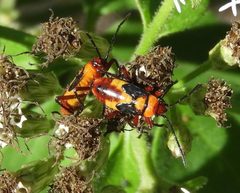
Oncopeltus guttaloides is a in the Lygaeidae, closely related to the well-studied (). The occurs in southern Central America, the Caribbean, and the southern United States. Its nymphs are gregarious and form large clusters on plants. Like other Oncopeltus species, it is associated with milkweed plants and exhibits aposematic coloration.
Pronunciation
How to pronounce Oncopeltus guttaloides: /ˌɔŋkoʊˈpɛltəs ˌɡʌtəˈlɔɪdiːz/
These audio files are automatically generated. While they are not always 100% accurate, they are a good starting point.
Identification
Oncopeltus guttaloides can be distinguished from the similar by geographic range and subtle morphological differences described by Slater (1964). The exhibits the characteristic orange and black aposematic coloration common to milkweed-feeding Oncopeltus. Precise identification requires examination of genitalic structures and comparison with .
Images
Habitat
Associated with milkweed plants (Asclepias ), particularly in open, sunny environments where plants grow.
Distribution
Southern United States, Cuba, Guatemala, Honduras, Jamaica, Mexico, and Santo Domingo (Dominican Republic). Records span the Caribbean, Middle America, and southern North America.
Diet
Feeds on seeds of milkweed plants, using to penetrate seed pods and extract liquefied nutrients.
Host Associations
- Asclepias - plantmilkweed seeds
Life Cycle
Nymphs are gregarious and occur in large clusters on plants. Development involves with , nymph, and stages. Multiple likely occur annually in warmer portions of the range.
Behavior
Nymphs exhibit gregarious , forming dense on plants. and nymphs cluster on developing seed .
Ecological Role
As a milkweed seed , reduces seed production of plants. Sequesters cardiac glycosides from milkweeds, contributing to Müllerian mimicry complexes with other aposematic milkweed .
Similar Taxa
- Oncopeltus fasciatusNearly identical orange and black coloration and shared milkweed plants, but O. fasciatus has a more northerly distribution and undergoes well-documented . O. guttaloides occurs further south and its migratory has not been confirmed.
- Lygaeus kalmiiAnother milkweed-feeding lygaeid with similar coloration, but smaller and with different pattern elements.
More Details
Taxonomic note
Described by Slater in 1964, this is part of a complex of Oncopeltus species specialized on milkweeds. Its is less studied than the model organism O. fasciatus.
Chemical ecology
Like other milkweed-feeding Oncopeltus, O. guttaloides likely sequesters cardiac glycosides from plants for defense against , though this has not been directly documented.
Sources and further reading
- BugGuide
- Wikipedia
- GBIF taxonomy match
- iNaturalist taxon
- Catalogue of Life
- A Unique Connection and a Living Legacy | Bug Squad
- What do insects do in winter? Migrants in the DMV: Common Buckeye, Junonia coenia, Variegated Fritillary, Euptoieta Claudia, Painted Lady, Vanessa cardui, Large Milkweed bug, Oncopeltus fasciatus — Bug of the Week
- Bugs in Orange and Black: Monarch Butterfly, Milkweed Leaf Beetle, Milkweed Bug, and Milkweed Tiger Moth — Bug of the Week
- Bugs in Orange and Black II: Large milkweed bug, Oncopeltus fasciatus — Bug of the Week
- Orange and Black II: Milkweed leaf beetle, Labidomera clivicollis; Oleander aphid, Aphis nerii; Milkweed Bug, Oncopeltus fasciatus; Monarch, Danaus plexippus — Bug of the Week
- Bugs in orange and black - Monarch butterfly, Danaus plexippus Milkweed Bug - Oncopeltus fasciatus; Milkweed tiger moth, Euchaetes egle — Bug of the Week