
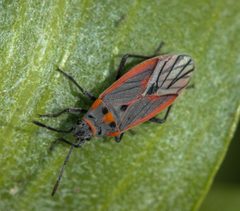
Melacoryphus nigrinervis
(Stål, 1874)
Black-veined Seed Bug
Melacoryphus nigrinervis is a in the Lygaeidae, commonly known as the Black-veined Seed Bug. The has been documented in Colorado during unseasonably warm conditions in mid-November, suggesting activity extends later into fall than typical for many temperate insects. It belongs to a closely related to soapberry bugs, though specific ecological details remain limited in published sources.
Pronunciation
How to pronounce Melacoryphus nigrinervis: //ˌmɛ.ləˈkɔː.rɪ.fəs ˌnɪɡ.rɪˈnɜːr.vɪs//
These audio files are automatically generated. While they are not always 100% accurate, they are a good starting point.
Identification
Specific diagnostic characters not provided in available sources. As a member of Lygaeidae, it can be distinguished from the related Rhopalidae (soapberry bugs such as Jadera and Boisea) by structural features of the , , and openings, though precise field identification requires examination of these characters. The 'Black-veined ' suggests dark wing venation may be a distinguishing feature, but this is not confirmed.
Images
Habitat
Observed in rural-suburban interface along concrete bike paths in Colorado Springs. Specific microhabitat preferences not documented.
Distribution
Documented from USA (Colorado), Jamaica, Mexico, and Venezuela. Distribution records based on Slater (1964) as cited in GBIF.
Seasonality
have been observed active in mid-November in Colorado under unseasonably warm conditions (77°F), suggesting potential for extended fall activity. Normal seasonal pattern not established.
Similar Taxa
- Melacoryphus lateralisCongeneric observed in in similar (Arizona); related and likely similar in appearance and , though specific distinguishing features not provided.
- Jadera haematolomaRelated in Rhopalidae with similar ('Red-shouldered Bug' vs. 'Black-veined Seed Bug'); both associated with soapberry plants and may occur in similar , but belongs to different family.
- Boisea spp.Boxelder bugs in Rhopalidae; frequently confused with related seed bugs due to similar size, coloration, and , though distinct family-level classification.
More Details
Climate observation context
The 2016 observation in Colorado Springs occurred during record warm temperatures and drought conditions. The observer noted this as part of a pattern of extended insect activity into late fall, with concerns about potential impacts in the following spring. This single observation should not be interpreted as established for the .