
Ambrysus
Stål, 1861
creeping water bugs, saucer bugs
Species Guides
13- Ambrysus arizonus
- Ambrysus buenoi
- Ambrysus californicus(California creeping water bug)
- Ambrysus circumcinctus(creeping water bug)
- Ambrysus hungerfordi
- Ambrysus hybridus
- Ambrysus lunatus(creeping water bug)
- Ambrysus mormon(creeping water bug)
- Ambrysus occidentalis
Ambrysus is a of creeping water bugs ( Naucoridae) containing more than 90 described . These aquatic insects are found primarily in running streams across the New World, from northern North America to Argentina, with greatest diversity in Mexico. They possess flattened, rounded bodies and powerful claws for clinging to rocks in turbulent water. The genus includes two subgenera: Ambrysus (Syncollus) and Ambrysus (Ambrysus).
Pronunciation
How to pronounce Ambrysus: /ˈæm.brɪ.səs/
These audio files are automatically generated. While they are not always 100% accurate, they are a good starting point.
Identification
Distinguished from other Naucoridae by genitalic characters, particularly male phallosoma structure and associated . -level identification requires examination of male and female genitalia. Distinguished from giant water bugs (Belostomatidae) by smaller size and different body proportions. Distinguished from water boatmen (Corixidae) by more flattened body and clinging rather than swimming . Subgenus Syncollus distinguished from Ambrysus by specific morphological features of the genitalia.
Images
Appearance
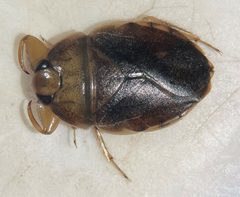
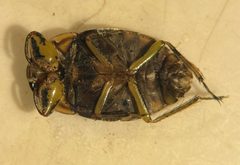
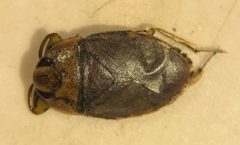
Flattened, oval to rounded body shape resembling a saucer. range from approximately 5–10 mm in length. Dark coloration with some showing orange or patterned wing markings. Powerful claws on forelegs for gripping substrate. Wings typically dark and held flat over . Beak-like rostrum for piercing prey. Some species with distinctive male genitalia structures used in species identification.
Habitat
Running streams and rivers, typically in turbulent, rocky areas. Found clinging to rocks, gravel, and submerged vegetation in flowing water. Some occur in still water and a few have been recorded from waterfalls. Occupies lotic freshwater environments from cloud forest streams to lowland rivers.
Distribution
New World distribution from northern North America (United States) through Mexico and Central America to Argentina. Greatest in Mexico. Some show restricted distributions: for example, Ambrysus signoreti is restricted to eastern Mexico in the Sierra Madre Oriental and associated biogeographic provinces. Several are to specific regions such as Baja California or coastal California ranges.
Diet
. Pierces prey with hardened beak and draws internal fluids through straw-like mouthparts. Prey includes other aquatic insects and small fish. Specific dietary composition varies by and .
Life Cycle
Hemimetabolous development without larval or pupal stages. Nymphs resemble in form, differing primarily in size, wing development, and sexual maturity. Five nymphal instars have been described for some (instars I, III, IV, V documented for A. attenuatus). Both nymphal and adult stages are fully aquatic.
Behavior
Clings to rocks and substrate in flowing water using powerful claws; does not swim actively like some other aquatic . Captures prey by piercing with rostrum. Underwater respiration via air bubble carried beneath wings (physical gill), with dissolved oxygen diffusing into the bubble from surrounding water. Some related use respiration (film of air held by body setae), though this has not been explicitly documented for Ambrysus.
Ecological Role
in freshwater stream . Functions as part of benthic macroinvertebrate in lotic environments. Likely contributes to nutrient cycling through on other aquatic insects and small vertebrates.
Human Relevance
Subject of taxonomic research due to high and complex groups. Collected by turning over rocks and using nets in streams. Some researchers have documented health risks (, , schistosomiasis) associated with fieldwork in tropical where these insects occur.
Similar Taxa
- BelostomatidaeGiant water bugs resemble Naucoridae in general form but are larger, have different leg proportions, and exhibit different predatory including active swimming and prey capture.
- CorixidaeWater boatmen share aquatic but have more streamlined bodies, swim actively using oar-like hind legs, and do not cling to substrate in flowing water.
- ProcryphocricosRelated in same Cryphocricinae with similar and use; distinguished by specific genitalic and structural characters.
More Details
Taxonomic complexity
The contains multiple (A. guttatipennis, A. hybridus, A. pulchellus) that have required extensive revision. Many new continue to be described, particularly from Mexico. Male genitalia provide primary characters for species delimitation.
Collection methods
Specimens are collected by turning over rocks and leaves in streams and capturing dislodged insects with nets placed downstream in the current. This method requires experience in fast-flowing, often remote .
Sources and further reading
- BugGuide
- Wikipedia
- GBIF taxonomy match
- iNaturalist taxon
- NCBI Taxonomy
- Catalogue of Life
- Ambrysus-cayo-kevin-wp - Entomology Today
- Two New Creeping Water Bug Species Found in Belize and Peru
- Procryphocricos pilcopata Archives - Entomology Today
- The Ambrysus Stal (Heteroptera : Naucoridae) of Mexico : revision of Ambrysus (Syncollus) La Rivers and species groups of Ambrysus (Ambrysus)
- Redescripción de Ambrysus (Ambrysus) attenuatus Montandon y descripción de las larvas V, IV, III y I (Hemiptera: Naucoridae)
- Northern Distribution ofAmbrysus mormonMontandon (Heteroptera: Naucoridae)
- Life History and Descriptions of Immature Stages of Ambrysus lunatus lunatus (Hemiptera: Naucoridae)
- Revision of the Ambrysus pulchellus Montandon species complex (Heteroptera: Nepomorpha: Naucoridae)
- The Mating Behavior of a Creeping Water Bug, Ambrysus occidentalis (Hemiptera: Naucoridae)
- Distribution of the Mexican saucer bug Ambrysus signoreti Stål, 1862 (Heteroptera, Nepomorpha, Naucoridae, Ambrysinae)
- Revision of the Ambrysus guttatipennis Stål species complex (Heteroptera: Naucoridae: Cryphocricinae) with the descriptions of six new species from Mexico
- Revision of the Ambrysus hybridus Montandon species complex (Heteroptera: Naucoridae: Cryphocricinae) with the description of a new species from Mexico