
Naucoridae
Leach, 1815
creeping water bugs, saucer bugs
Genus Guides
4- Ambrysus(creeping water bugs)
- Cryphocricos
- Limnocoris
- Pelocoris(Alligator Fleas)
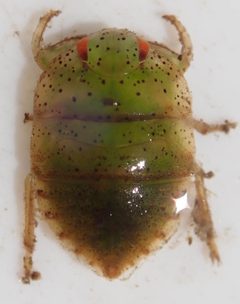
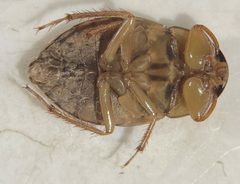
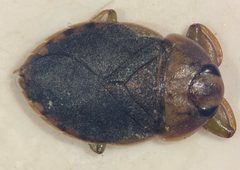
is a of aquatic predatory true bugs comprising approximately 400 in 46 across five . Members are commonly known as creeping water bugs or saucer bugs due to their dorsoventrally flattened, oval body shape. They inhabit freshwater environments worldwide with greatest diversity in tropical regions, ranging from still waters to torrential streams. Most species are lotic, occurring in flowing waters rather than lentic . They are predatory, feeding on other small using .
Pronunciation
How to pronounce Naucoridae: //naʊˈkɔːrɪdiː//
These audio files are automatically generated. While they are not always 100% accurate, they are a good starting point.
Identification
are distinguished from the similar Belostomatidae (giant water bugs) by their considerably smaller size (0.5–2 cm versus 2–12 cm), more flattened oval body shape, and lack of forelegs adapted for catching vertebrate prey. They possess four-segmented approximately 500–1100 µm in length with eleven distinct types. Members of the Cryphocricinae use plastral respiration (air film held by hydrofuge setae), while other subfamilies typically use bubble respiration tucked under the wings.
Images
Habitat
Freshwater aquatic including ponds, lakes, rivers, streams, and waterfalls. -specific habitat preferences exist: Cheirochelinae inhabit strong currents; Cryphocricinae occur in rapid streams under stones and gravel; Limnocorinae are found in shallow streams associated with leaf packs or riparian vegetation roots; Laccocorinae occupy stream edges and quiet pools avoiding strong currents; Naucorinae prefer stagnant water or sluggish bays.
Distribution
Worldwide distribution with greatest diversity in tropical regions. Present on all continents except Antarctica.
Diet
Predatory; feeds on other small including insects, aquatic snails, small crustaceans, and small fish. One record of necrophagy exists for Naucoris maculatus.
Life Cycle
Hemimetabolous development with no larval or pupal stages. Nymphs resemble , differing primarily in size, wing development, and sexual maturity. Postembryonic development timing varies by latitude: begins April in Bulgaria (Southeastern Europe), May in Central Europe, and June in western Siberia. Ilyocoris cimicoides is with one per year.
Behavior
Good swimmers that cling to substrates using powerful claws, particularly in turbulent . Cryphocricinae and Ambrysus cling to rocks and gravel in fast-flowing streams. Naucorinae wait motionless between plants to ambush prey. Poor visual acuity; react to movement only within approximately two body-lengths distance. Some species show habitat-dependent : Ambrysus exhibits both swimming and crawling depending on conditions. can be washed out during severe spates, with taking months to over a year to recover.
Ecological Role
in freshwater . are sensitive to hydrological disturbance regimes, with spate events causing significant reductions and slow recolonization in some .
Similar Taxa
- BelostomatidaeSimilar flattened body shape and aquatic predatory habit, but distinguished by larger size (2–12 cm), forelegs for capturing vertebrate prey, and different respiratory strategies.
- AphelocheiridaeFormerly classified together in superfamily Naucoroidea, but now placed in separate superfamily Aphelocheiroidea; share aquatic predatory but lack antennal synapomorphies with .
- Corixidae (water boatmen)Related nepomorphan with aquatic habits, but distinguished by different body shape, swimming , and typically non-predatory or feeding.
Sources and further reading
- BugGuide
- Wikipedia
- GBIF taxonomy match
- iNaturalist taxon
- NCBI Taxonomy
- Catalogue of Life
- Two New Creeping Water Bug Species Found in Belize and Peru
- Naucoridae Archives - Entomology Today
- Revision of Limnocoris (Heteroptera: Nepomorpha: Naucoridae) of North America
- The variability of antennal sensilla in Naucoridae (Heteroptera: Nepomorpha)
- A new species, new synonymy, and notes on Neomacrocoris (Heteroptera: Nepomorpha: Naucoridae)
- Microhabitat Associations of Three Sympatric Species of Naucoridae (Insecta: Hemiptera)
- The Ambrysus Stal (Heteroptera : Naucoridae) of Mexico : revision of Ambrysus (Syncollus) La Rivers and species groups of Ambrysus (Ambrysus)
- First data on the phenology and spermatogenesis of Ilyocoris cimicoides (Heteroptera, Nepomorpha, Naucoridae) from the Balkan Peninsula
- Distribution of the Mexican saucer bug Ambrysus signoreti Stål, 1862 (Heteroptera, Nepomorpha, Naucoridae, Ambrysinae)
- Description of the female of Procryphocricos perplexus Polhemus (Hemiptera: Heteroptera: Naucoridae)
- Revision of Limnocoris Stål (Heteroptera: Nepomorpha: Naucoridae) of the tropical Andes
- Revision of the Ambrysus pulchellus Montandon species complex (Heteroptera: Nepomorpha: Naucoridae)
- Pelocoris balius La Rivers (Hemiptera: Heteroptera: Naucoridae) in Florida: New Status of an Enigmatic Saucer Bug
- Revision of Limnocoris Stål (Heteroptera: Nepomorpha: Naucoridae) of the Guiana Shield and Amazon regions
- How Abiotic Factors Affect the Distribution of Two Species of Tropical Predaceous Aquatic Bugs (Family: Naucoridae)
- A new species of Limnocoris Stål (Heteroptera: Naucoridae: Limnocorinae) and new state records for species of the genus in Mexico
- The Mating Behavior of a Creeping Water Bug, Ambrysus occidentalis (Hemiptera: Naucoridae)
- Hidden diversity in neglected structures: A morphological study of the terminalia of Limnocoris Stål, 1860 (Hemiptera: Heteroptera: Naucoridae), with descriptions of two new species from Brazil and taxonomic notes.