
Stenopodainae
Amyot & Serville, 1843
Genus Guides
9Stenopodainae is a of assassin bugs (Reduviidae) containing approximately 113 and ~770 worldwide. Members are predominantly tropical, with many species associated with soil or sand substrates. The subfamily is characterized by distinctive morphological features including prominent mandibular plates and a modified antennal structure. Many species exhibit wing reduction (aptery) and cryptic coloration. Some species have been observed to use plant-derived resin on their forelegs to aid in prey capture.
Pronunciation
How to pronounce Stenopodainae: /ˌstɛnəˌpoʊdəˈnaɪ.i/
These audio files are automatically generated. While they are not always 100% accurate, they are a good starting point.
Identification
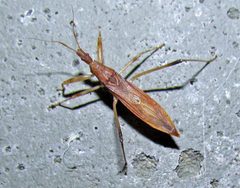
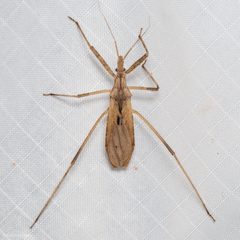
Distinguished from other Reduviidae by the combination of prominent mandibular plates, the strongly developed first antennal segment with slender, reflexed remaining segments, and the characteristic pentagonal or hexagonal in the . forms may be confused with other ground-dwelling heteropterans but can be identified by Reduviidae-specific features such as the curved rostrum fitting into a groove beneath the .
Images
Appearance
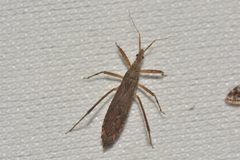
Cryptically colored, often in earth tones. Prominent mandibular plates present. First antennal segment strongly developed, enlarged; remaining segments slender and frequently folded back beneath the first segment. typically with a large pentagonal or hexagonal in the . Many are (wingless) or exhibit wing reduction.
Habitat
Many are associated with soil or sand substrates. Some species inhabit tropical rainforests. Pygolampis striata has been collected from surfaces of dried Poaceae grasslands. Specific microhabitat preferences vary considerably among .
Distribution
Predominantly tropical distribution worldwide. Most diverse in the Neotropics, Afrotropics, and Oriental realms. Records include: Sub-Saharan Africa and Asia (Argolis); Maharashtra, India (Canthesancus); Punjab region of India; East Asia (Stachyotropha); Japan and Indonesia (Pygolampis); French Guiana and Surinam (Nitornus); Argentina (Narvesus); and America north of Mexico (Diaditus).
Diet
Predatory. Some have been observed to smear forelegs with sticky, plant-derived resin to aid in prey capture.
Life Cycle
is pronounced in some ; males and females of Argolis were originally described as separate genera due to morphological differences. complements typically include autosomal numbers of 20/22 (n=10A/11A) with multiple systems (XnY/XnXn); documented karyotypes include 2n=23=20A+X1X2Y. No microchromosomes present.
Behavior
Some use plant-derived resin applied to forelegs as a prey capture strategy. Many species are ground-dwelling or associated with soil substrates.
Ecological Role
in soil and ground-level .
Similar Taxa
- Other Reduviidae subfamiliesStenopodainae distinguished by the enlarged first antennal segment with reflexed remaining segments, prominent mandibular plates, and pentagonal/hexagonal corial
More Details
Chromosomal characteristics
The exhibits distinctive cytogenetic features: autosomal numbers typically 20/22 (n=10A/11A), multiple systems (XnY/XnXn), and absence of microchromosomes. Documented in Oncocephalus notatus and Sastrapada baerensprungi with 2n=23=20A+X1X2Y karyotype.
Taxonomic complexity
has historically caused taxonomic confusion. In Argolis, males and females were originally described as separate (Bardesanes, Neoklugia) before being synonymized. The contains approximately 113 described genera with ongoing taxonomic revision.
Sources and further reading
- BugGuide
- Wikipedia
- iNaturalist taxon
- NCBI Taxonomy
- Catalogue of Life
- A Revision of the Genus Argolis (Hemiptera: Reduviidae: Stenopodainae) from Asia
- First record of Canthesancus gulo Stal, 1863 (Reduviidae, Stenopodainae) from Maharashtra, India
- Chromosomes and Their Meiotic Behavior in Two Species of Stenopodainae (Heteroptera: Reduviidae)
- New records for the genus Diaditus (Hemiptera: Heteroptera: Reduviidae: Stenopodainae) in America north of Mexico
- New records of species of Nitornus Stål, 1859 (Hemiptera: Reduviidae: Stenopodainae) from French Guiana and Surinam
- Re-description of the assassin bug species Pygolampis striata Miller, 1940 with new distributional records from Japan and Indonesia (Heteroptera, Reduviidae, Stenopodainae)
- A new synonym of a species of Stachyotropha Stål, 1871, a genus of Asian Stenopodainae (Hemiptera, Heteroptera, Reduviidae)
- Revision of the genus Narvesus Stål, 1859 (Hemiptera: Heteroptera: Reduviidae: Stenopodainae) and a new record for Argentina
- Figure 3d from: Okuda K (2021) Re-description of the assassin bug species Pygolampis striata Miller, 1940 with new distributional records from Japan and Indonesia (Heteroptera, Reduviidae, Stenopodainae). Biodiversity Data Journal 9: e63695. https://doi.org/10.3897/BDJ.9.e63695
- Figure 3a from: Okuda K (2021) Re-description of the assassin bug species Pygolampis striata Miller, 1940 with new distributional records from Japan and Indonesia (Heteroptera, Reduviidae, Stenopodainae). Biodiversity Data Journal 9: e63695. https://doi.org/10.3897/BDJ.9.e63695
- Figure 3c from: Okuda K (2021) Re-description of the assassin bug species Pygolampis striata Miller, 1940 with new distributional records from Japan and Indonesia (Heteroptera, Reduviidae, Stenopodainae). Biodiversity Data Journal 9: e63695. https://doi.org/10.3897/BDJ.9.e63695
- Figure 3b from: Okuda K (2021) Re-description of the assassin bug species Pygolampis striata Miller, 1940 with new distributional records from Japan and Indonesia (Heteroptera, Reduviidae, Stenopodainae). Biodiversity Data Journal 9: e63695. https://doi.org/10.3897/BDJ.9.e63695
- Figure 1 from: Okuda K (2021) Re-description of the assassin bug species Pygolampis striata Miller, 1940 with new distributional records from Japan and Indonesia (Heteroptera, Reduviidae, Stenopodainae). Biodiversity Data Journal 9: e63695. https://doi.org/10.3897/BDJ.9.e63695
- A new species of Kodormus Barber, with a redescription of the genus, taxonomic notes, and a key to the species of the genus (Hemiptera, Heteroptera, Reduviidae, Stenopodainae).