
Nabis capsiformis
Germar, 1838
Pale Damsel Bug
Nabis capsiformis, commonly known as the pale , is one of the most widespread in the Nabis. It is a found across six continents including Africa, Europe, the Americas, and Oceania. The species is particularly abundant in agricultural where it serves as a biocontrol agent. Both nymphs and are effective predators using front legs to capture prey.
Pronunciation
How to pronounce Nabis capsiformis: /ˈneɪbɪs kæpˈsɪfɔrmɪs/
These audio files are automatically generated. While they are not always 100% accurate, they are a good starting point.
Identification
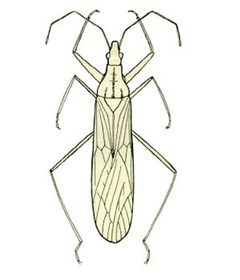
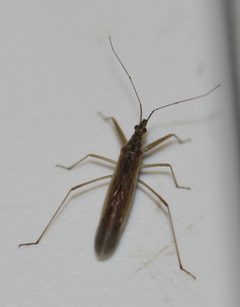
The pale can be distinguished from other true bugs by the absence of a —a pronounced wrinkle or notch in the front wing margin found in plant bugs (Miridae). It differs from assassin bugs (Reduviidae) by its smaller size, typically under 12 mm. The holds its front legs raised in a posture resembling a curtsey, giving damsel bugs their . The of the front leg is muscular and swollen, lined with spines on the underside for securing prey. Some individuals may be wingless or have abbreviated non-functional wings.
Images
Habitat
Open areas including coastal and field and row crop agroecosystems. The is commonly reported throughout the southeastern United States across a variety of .
Distribution
Africa, the Caribbean, Europe and Northern Asia (excluding China), Central America, North America, Oceania, and South America. Distribution records include the Azores (Faial, Flores, São Miguel, Santa Maria).
Seasonality
Observed as from early spring through late fall. Attracted to lights at night.
Diet
feeding on lepidopteran , aphids, and other small insects. Small nymphs typically consume one lepidopteran egg or per day; later instars and can consume up to two dozen eggs or other prey daily. Becomes cannibalistic when other prey are unavailable. Can survive up to two weeks without food.
Life Cycle
Development from to requires 325 above a threshold of 11.3°C. At 23°C, mean adult female longevity is 30 days (maximum 43 days) with an oviposition rate of 10.4 eggs per day.
Behavior
that uses thickened front legs lined with spines to catch and hold prey, then sucks out body contents with piercing mouthparts. Often attracted to lights at night, likely to prey on other insects drawn there. Solitary rather than swarming. Timid and not prone to biting humans; possesses venom that paralyzes prey and initiates digestion.
Ecological Role
in agroecosystems and natural . Considered economically important for pest control in agricultural systems. Among the most abundant small predators in crop fields. Preys on agricultural pests including lygus bugs.
Human Relevance
Valued as a biocontrol agent in field and row crop agriculture. Helps suppress pest including lepidopteran and aphids without chemical intervention.
Similar Taxa
- Miridae (plant bugs)Similar body form but distinguished by the presence of a —a pronounced wrinkle or notch in the front wing margin near where the leathery portion meets the .
- Reduviidae (assassin bugs)Both have short rostrums compared to plant-feeding , but assassin bugs are generally larger than damsel bugs.
- Pagasa spp.Another of damsel bugs; Pagasa are small, dark, ground-dwelling, and almost -like in appearance with reduced wings or wingless forms.
More Details
Physiological thresholds
Developmental threshold of 11.3°C; calculated as 8.366 female per 1000 above this threshold.
Temperature effects on reproduction
Higher temperatures reduce longevity and increase oviposition rate when calculated on physiological time above the developmental threshold.
Sources and further reading
- BugGuide
- Wikipedia
- GBIF taxonomy match
- iNaturalist taxon
- NCBI Taxonomy
- A Big Cheer for a Crab Spider | Bug Squad
- Bug Eric: Damsels That Cause Distress
- Bug Eric: My Kind of Fourth of July
- Bug Eric: Blacklighting Already?
- Bug Eric: July 2019
- Pale Damsel Bug Nabis capsiformis Germar (Insecta: Hemiptera: Nabidae)
- BIOLOGY AND TEMPERATURE RELATIONSHIPS OF CHRYSOPA SP., MICROMUS TASMANIAE AND NABIS CAPSIFORMIS