
Lygus striatus
Knight, 1917
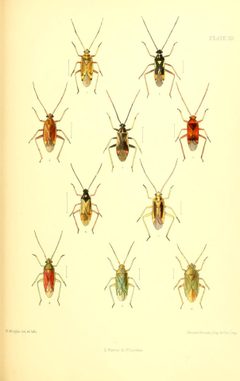
Lygus striatus is a of plant bug in the Miridae, first described by Knight in 1917. It belongs to the Lygus, which contains several economically significant agricultural pests. The species is distributed across western North America, with records from the western United States and western Canada. Like other members of its genus, it is likely associated with herbaceous vegetation, though specific ecological details remain poorly documented compared to better-studied such as Lygus hesperus and Lygus lineolaris.
Pronunciation
How to pronounce Lygus striatus: /ˈlaɪɡəs straɪˈeɪtəs/
These audio files are automatically generated. While they are not always 100% accurate, they are a good starting point.
Images
Distribution
Recorded from western North America including the Canadian provinces of Alberta, British Columbia, and Saskatchewan, and the United States from Arizona, California, Colorado, Montana, New Mexico, Oregon, South Dakota, Utah, and Washington. The distribution corresponds to the Western Nearctic biogeographic region excluding Beringia.
Similar Taxa
- Lygus hesperusWestern is a closely related with overlapping western North American distribution; distinguished by specific markings and more extensive agricultural pest documentation
- Lygus lineolaris is the most widespread and economically important Lygus in North America; differs in distribution pattern and preferences
- Lygus elisusPale legume is another western North American with similar associations; specific morphological differences separate the
More Details
Taxonomic Status
The is accepted and valid, with authorship attributed to Knight, 1917. It is part of a large containing approximately 40+ species, many of which are difficult to distinguish morphologically.
Data Deficiency
Lygus striatus appears to be significantly less studied than L. hesperus, L. lineolaris, and L. elisus, which dominate agricultural pest literature. Available sources provide minimal -specific biological information.
Sources and further reading
- BugGuide
- GBIF taxonomy match
- iNaturalist taxon
- NCBI Taxonomy
- Catalogue of Life
- Occasional Pests - AgriLife Extension Entomology
- What You Should Know about 'Berries Vs. Bugs' | Bug Squad
- High Honor for Emily Bick: ESA Student Certification Award | Bug Squad
- Don't Miss This UC Davis Seminar by Ecology Researcher Andrew Corbett | Bug Squad
- Bembicid Holdings | Entomology Research Museum
- From Burglars to Bugs: Anti-Theft Dye Useful in Insect-Tracking Studies