
Stictocephala
Stål, 1869
buffalo treehoppers
Species Guides
17- Stictocephala albescens
- Stictocephala alta
- Stictocephala basalis
- Stictocephala bisonia(Buffalo Treehopper)
- Stictocephala brevicornis(Buffalo Treehopper)
- Stictocephala brevis
- Stictocephala brevitylus
- Stictocephala diceros(Two-horned Treehopper)
- Stictocephala diminuta
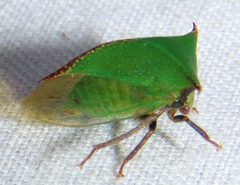
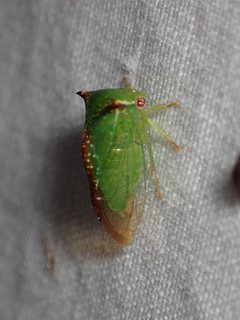
Stictocephala is a of treehoppers in the Membracidae, characterized by a prominent pronotum that extends over the body. The genus contains approximately 18 described , most distributed in North America. Several species, notably S. bisonia, have become pests in Europe and Asia, with documented spread to Russia, China, and India. These invasions have occurred primarily within the last 20-30 years, facilitated by climate change and global trade.

Pronunciation
How to pronounce Stictocephala: /stɪktoʊˈsɛfələ/
These audio files are automatically generated. While they are not always 100% accurate, they are a good starting point.
Images
Distribution
Native range centered in North America. S. bisonia introduced to Europe over 100 years ago; actively spreading across European Russia since 1992, with 26+ regions confirmed by 2022 and northern limit at Nizhny Novgorod. First recorded in China in 2017. First recorded in India (Jammu and Kashmir) in 2024.
Seasonality
For S. bisonia in European Russia: observed from third decade of June; peak abundance in second and third decades of July and August.
Host Associations
- Liquidambar styraciflua - for S. militaris
- Vitis spp. - for S. bisonia in India
- Various fruit trees - S. bisonia assumed to damage young fruit trees and berry bushes
Ecological Role
S. bisonia is an pest with expanding distribution in the northern hemisphere. The possesses gene expansions in detoxification (P450, ABC), chemosensory (CSP), and immune (PGRP) genes that may facilitate to new environments. All examined individuals two bacterial (Sulcia and Nasuia lineage betaproteobacteria) that are transovarially transmitted.
Human Relevance
S. bisonia causes agricultural damage to grapevines, fruit trees, and berry bushes. The has potential to transmit phytoplasmas affecting fruit trees. Climate change is predicted to expand suitable eastward across Asia.
Similar Taxa
- Membracidae (other genera)Other share the enlarged pronotum characteristic, but Stictocephala typically have a distinctive bison-like or buffalo-like pronotal shape, particularly pronounced in S. bisonia
Sources and further reading
- BugGuide
- Wikipedia
- GBIF taxonomy match
- iNaturalist taxon
- NCBI Taxonomy
- Catalogue of Life
- Stictocephala militaris, a Membracid (Homoptera) Associated with Sweetgum, Liquidambar styraciflua
- Characteristics of development and damage of Stictocephala bubalus f. in Verishen community of Syunik marz
- Invading the North: Dispersal of Nearctic treehopper Stictocephala bisonia (Hemiptera: Cicadomorpha: Membracidae) in European Russia
- Distribution and trophic relationships of the buffalo treehopper, Stictocephala bisonia, in the Samara region of Russia
- Conservatism and stability of the symbiotic system of the invasive alien treehopper Stictocephala bisonia ( Hemiptera, Cicadomorpha, Membracidae )
- Chromosome‐level genome assembly of the invasive pest Stictocephala bisonia : insights into genes for environmental stress adaptation
- Source of Introduction to China and Global Suitable Habitat Prediction for the Invasive Insect Stictocephala bisonia (Hemiptera: Membracidae)
- Investigating the Enigmatic and Invasive Entomofaunal Diversity of Temperate Viticulture: First Record of the Nearctic buffalo treehopper <i>Stictocephala bisonia</i> (Kopp & Yonke) and a Previously Undocumented <i>Altica</i> Species (<i>Altica aenescens</i>) (Weise, 1888) from India
- Open-source insect camera trap with vibrational detection and luring for monitoring Stictocephala basalis (Walker, Hemiptera: Membracidae: Smiliinae).