
Rugosana
DeLong, 1942
Species Guides
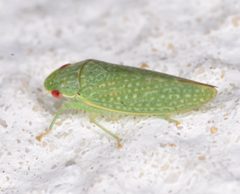
10Rugosana is a of leafhoppers in the Cicadellidae, described by DeLong in 1942. The genus belongs to the tribe Gyponini and Iassinae. are distributed in North America. One observed species displays bright green coloration with distinctive red .
Pronunciation
How to pronounce Rugosana: //ˌruːɡoʊˈsɑːnə//
These audio files are automatically generated. While they are not always 100% accurate, they are a good starting point.
Identification
Members of Rugosana can be distinguished from similar leafhoppers by their placement in the tribe Gyponini. One documented exhibits a striking combination of bright green body coloration with red , which may serve as a useful visual cue for field identification. The name likely refers to (wrinkled or rough) surface texture, though this character requires verification.
Images
Habitat
Observed in dry, mixed conifer forest with oak components at approximately 7,000 feet elevation in the southwestern United States. Attracted to artificial lighting at night, suggesting or activity patterns.
Distribution
North America. Documented occurrence in Grant County, New Mexico, USA.
Seasonality
have been observed in late August in the southwestern United States.
Behavior
Attracted to blacklights and porch lights at night. This has been documented in mixed conifer-oak forest .
Similar Taxa
- AphrophoraConifer spittlebugs in this are easily mistaken for leafhoppers including Rugosana due to similar body plan and association; they belong to Cercopidae (or Aphrophoridae), distinguished by different structure and nymphal spittle production.
- GyponaCongeneric members of tribe Gyponini share morphological similarities; -level or -level distinction requires examination of genitalic characters.
More Details
Taxonomic placement
Rugosana is classified in the tribe Gyponini, Iassinae, within the megadiverse leafhopper Cicadellidae. This tribe contains numerous North American that are morphologically similar and often require expert identification.
Observation context
The primary behavioral observation comes from a single blacklighting event in New Mexico, where a Rugosana was noted among diverse insects. This suggests the may be more frequently encountered through nocturnal sampling methods than daytime collecting.