
Ephemera guttulata
Pictet, 1843
Eastern Green Drake, Shad Fly, Coffinfly
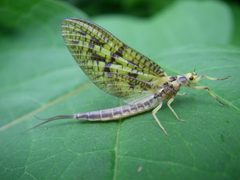
Ephemera guttulata, commonly known as the eastern green drake, is a burrowing native to eastern North America. It is one of the largest mayfly species in the region and is highly significant to fly fishing, where its events are eagerly anticipated. The species has a fully aquatic larval stage, followed by a winged subimago (dun) stage and a short-lived sexually mature () stage. Its conservation status is G5 (secure) according to NatureServe.


Pronunciation
How to pronounce Ephemera guttulata: /ɛˈfɛmərə ɡʌtjʊˈlɑːtə/
These audio files are automatically generated. While they are not always 100% accurate, they are a good starting point.
Identification
The eastern green drake is among the largest in eastern North America. can be distinguished by their size and coloration, though specific diagnostic features are not detailed in available sources. The subimago (dun) stage has wings, while the fully mature (spinner) stage represents the final reproductive form. Larvae are burrowers in sandy or muddy substrates.
Images
Habitat
Larvae inhabit freshwater systems with sandy or muddy bottoms where they construct burrows. The is associated with rivers and streams suitable for burrowing .
Distribution
to the eastern seaboard of the United States and Canada. Range extends west to Ontario and Arkansas but no farther. Present throughout the continental United States and Canada within this eastern zone.
Diet
Larvae are filter-feeders and collectors, consuming organic particles and detritus from the water column and substrate. Specific dietary details for are not documented; adult mayflies typically do not feed.
Life Cycle
The consists of three stages: a fully aquatic larval stage, a flying sexually stage called the subimago (or dun), and a short-lived sexually mature adult stage (). Larvae are aquatic burrowers. The subimago into the imago, which mates and dies shortly after.
Behavior
Larvae construct and inhabit burrows in sandy or muddy stream bottoms. are known for synchronous mass events that create significant feeding opportunities for fish. The subimago stage must sit on the water surface to allow wings to dry before , making them vulnerable to .
Ecological Role
Larvae function as benthic and filter-feeders, processing organic matter in freshwater . Both larval and stages serve as critical prey for fish, particularly trout. Mass events represent major nutrient pulses linking aquatic and terrestrial .
Human Relevance
Highly significant to recreational fly fishing. The is considered one of the most important hatches in eastern North American trout streams. Anglers use specialized fly patterns to imitate the dun and spinner stages. Multiple reflect its importance: "eastern green drake," "shad fly," and "coffinfly."
Similar Taxa
- Ephemera simulansAnother large burrowing in the same ; both are important to anglers and require careful imitation with specific fly patterns.
- Hexagenia limbataLarge with mass events important to anglers; distinguished by different affiliation and typically different preferences (Hexagenia often in lakes, Ephemera in rivers).
More Details
Fly Fishing Significance
The eastern green drake is considered one of the most challenging and rewarding hatches for fly fishermen. Trout become highly selective during , requiring precise imitation of size, silhouette, and . The extended body and parachute patterns are commonly used fly designs.
Conservation Status
Ranked G5 (globally secure) by NatureServe, indicating the is widespread and abundant with no immediate conservation concerns.
Sources and further reading
- BugGuide
- Wikipedia
- GBIF taxonomy match
- iNaturalist taxon
- NCBI Taxonomy
- Catalogue of Life
- Bohart Bugs Beckon at Vacaville Museum's Exhibit | Bug Squad
- Bohart Museum Spotlight on Yellow-Bellied Burying Beetles | Bug Squad
- Teach a Man to Fish (and some entomology) and You’ll Feed Him for a Lifetime
- Snap to it and bag a bagworm! - Thyridopteryx ephemeraeformis — Bug of the Week
- It’s a Mayfly…It’s a Moth…It’s Thyridopteryx | Beetles In The Bush
- Day hike at Little Lost Creek Conservation Area | Beetles In The Bush