
Chionea alexandriana
Garrett, 1922
snow fly
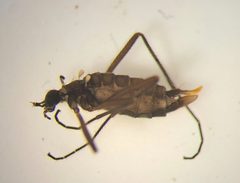
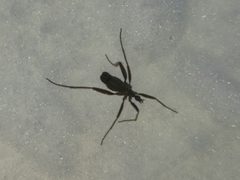
Chionea alexandriana is a wingless crane fly in the Limoniidae, commonly known as a snow fly. It is active during winter months on snow fields in western North American mountains. are small, measuring 4-8 mm, and are distinguished from related species by specific morphological traits including short and body coloration.
Pronunciation
How to pronounce Chionea alexandriana: /kʰiˈoʊ.ni.ə ˌæl.ɪɡˌzænˈdɹaɪə.nə/
These audio files are automatically generated. While they are not always 100% accurate, they are a good starting point.
Identification
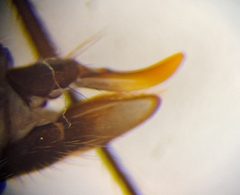
Distinguished from other Chionea by: (1) dark grayish brown versus other color patterns in related species; (2) light brown to brown body with midline stripe; (3) shorter than most , with only 3-4 flagellomeres; (4) geographic distribution in western North America. Thought to be most closely related to C. nigra, C. jellisoni, C. excavata, and C. lyrata based on and range.
Images
Appearance
are 4-8 mm in length. The is dark grayish brown. The body is light brown to brown with a midline stripe. are notably short, with only three to four flagellomeres—shorter than most other snow fly . The species is wingless.
Habitat
Snow fields at 3600-7000 feet elevation in mountainous regions. Occupies the subnivean environment—cavities beneath snow created by arching grass blades, leaf litter, and rodent tunnels. Also found beneath leaf litter and in caves, which provide insulation from severe weather.
Distribution
Western mountains of North America. Documented in Alberta, British Columbia, Washington, Oregon, Idaho, Montana, Utah, California, and Yukon.
Seasonality
Active from November to April. Most abundant during this period at temperatures ranging from 21-32°F (-6 to 0°C).
Life Cycle
The larval stage feeds and grows during summer months, with occurring in fall. take eight days to three weeks to hatch under laboratory conditions. females can produce up to 194 eggs, laid singly. Eggs may be stored in the thoracic cavity. Adults may live up to two months. Larval diet remains unknown; laboratory rearing attempts have failed due to lack of knowledge about larval food requirements.
Behavior
crawl across snow surfaces during winter. When not active on snow, they remain concealed in small mammal tunnels, beneath leaf litter, or in caves. Susceptible to overheating; adapted to function at lower temperatures than most insects through glycerol-based antifreeze in body fluids and cold-tolerant systems.
Ecological Role
Serves as prey for small mammals (including mice) and rock-crawlers (Grylloblattidae). Functions as intermediate for parasitic tapeworms that cycle through rodents.
Human Relevance
Does not bite or sting humans. Occasionally observed by winter recreationists in mountain areas. Subject of scientific interest due to extreme cold adaptations.
Similar Taxa
- Chionea nigraThought to be closely related based on and range; distinguished by C. alexandriana's shorter and specific color pattern
- Chionea jellisoniThought to be closely related based on and range; distinguished by C. alexandriana's shorter and specific color pattern
- Chionea excavataThought to be closely related based on and range; distinguished by C. alexandriana's shorter and specific color pattern
- Chionea lyrataThought to be closely related based on and range; distinguished by C. alexandriana's shorter and specific color pattern
More Details
Cold tolerance mechanisms
Possesses glycerol in body fluids acting as antifreeze to prevent ice crystal formation. Has systems allowing function at temperatures below those tolerated by most insects.
Taxonomic note
Limoniidae was formerly treated as a (Limoniinae) of Tipulidae.