
Chionea scita
Walker, 1848
snow crane fly, snow fly
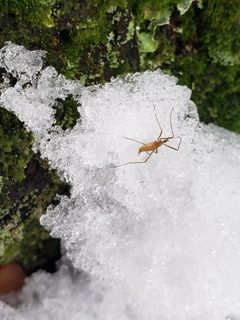
Chionea scita is a wingless crane fly native to North America, notable for its winter activity and ability to walk on snow at temperatures as low as 14°F. emerge between September and February, with peak activity in November and December. The is commonly found in the northeastern United States and Canada, extending south to Georgia and Tennessee. Both sexes are yellow-brown, hairy, and spider-like in appearance, with body lengths of 5–8 mm.
Pronunciation
How to pronounce Chionea scita: /kiˈoʊniə ˈskɪtə/
These audio files are automatically generated. While they are not always 100% accurate, they are a good starting point.
Identification
Distinguished from other crane flies by complete winglessness in . Separated from other Chionea by female that are less elongated and uniformly curved. Males identified by enlarged and characteristic genitalia structure. May be confused with spiders due to hairy, wingless appearance, but possesses only six legs and insect body plan.
Images
Habitat
Found on snow surfaces, in lightly wooded forests, and deep inside caves far from exits. Occupies the subnivean environment—cavities beneath snow formed by arching grass blades, leaf litter, and rodent tunnels—which provides thermal insulation. May be associated with small mammal nesting sites, though this requires further study.
Distribution
Native to North America. Common throughout the continental United States and Canada. Range extends from Ontario and Quebec south through Vermont to Indiana, Kentucky, Tennessee, and Georgia. Primarily distributed in colder regions with winter snow cover.
Seasonality
emerge between September and February, with one per year. Peak activity occurs in November and December. Northern appear as early as September; southern populations may emerge as late as February. Adults can survive for several months.
Life Cycle
Females lay in late winter or early spring after snowfall, when temperatures are between 28°F and 38°F. Eggs hatch in 8 days to 3 weeks under laboratory conditions. Larvae emerge in spring and feed and grow during summer months. occurs in fall. emerge in fall or early winter and may live up to two months. Larval diet unknown; laboratory rearing attempts have failed.
Behavior
walk slowly across snow surfaces at temperatures as low as 14°F. Mating occurs on snow piles or dead plant material. Adults occupy subnivean spaces for thermal protection. Susceptible to overheating; possesses glycerol in body fluids as antifreeze and systems adapted to low temperatures.
Ecological Role
Prey for small mammals such as mice, evidenced by tapeworm cysticeroid stages found in guts. Also preyed upon by grylloblattids (rock-crawlers) in high-elevation western . May serve as intermediate for parasitic tapeworms of rodents.
Human Relevance
Does not bite or sting humans. Occasionally observed by winter hikers and naturalists due to conspicuous activity on snow. Of scientific interest for cold physiology.
Similar Taxa
- Other Chionea speciesShare wingless, winter-active habit and snow- ; distinguished by details of female shape and male genitalia structure.
- Spiders (Araneae)Superficially similar hairy, wingless, long-legged appearance; distinguished by six legs (vs. eight), three body segments, and .
More Details
Etymology
name Chionea derives from Greek 'chion' meaning snow. epithet scita is Latin for beautiful or handsome.
Reproductive capacity
Winglessness eliminates bulky muscles, allowing females to carry up to 194 , including storage in the thoracic cavity normally occupied by wing muscles. Eggs are laid singly.