
Pyrgota
Wiedemann, 1830
waved light fly, light fly
Species Guides
2- Pyrgota fenestrata
- Pyrgota undata(waved light fly)
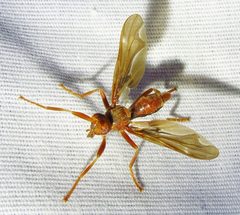
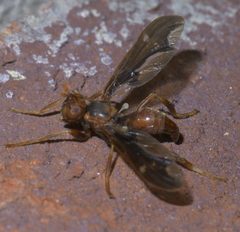
Pyrgota is a of flies in the Pyrgotidae, containing approximately 10 described . The genus is notable for its endoparasitoid lifestyle, with larvae developing inside scarab beetles (Melolonthinae). are often observed in mating pairs and exhibit distinctive , including a 'French kissing' interaction during copulation. The type species, Pyrgota undata, is commonly known as the waved light fly.
Pronunciation
How to pronounce Pyrgota: //pɪrˈɡoʊtə//
These audio files are automatically generated. While they are not always 100% accurate, they are a good starting point.
Identification
Distinguished from other pyrgotid by specific wing venation and body proportions. The -mimicking appearance separates them from most other dipteran . -level identification requires examination of male genitalia and wing patterns. Pyrgota undata can be recognized by its waved wing pattern and Polistes wasp-mimicking coloration.
Images
Habitat
are found in open including prairies, glades, and woodland edges. Associated with areas where scarab beetles are abundant. In Missouri, observed in recently burned glades and prairie habitats with diverse floral .
Distribution
Recorded from North America including the United States (Vermont, Missouri, New Mexico, Oklahoma, Florida). Specific distribution varies by ; Pyrgota undata has been documented in the Ozark region of Missouri.
Seasonality
active in spring and early summer. In Missouri, observed in May. Activity likely coincides with of adult beetles.
Host Associations
- Melolonthinae - endoparasitoidLarvae develop internally within scarab beetles. One observation documents Pyrgota sp. parasitizing one of two sympatric Polyphylla while avoiding the other, resulting in 10:1 abundance disparity.
Life Cycle
Endoparasitoid development: laid on or near beetles; larvae penetrate host and develop internally, eventually killing the host. Specific details of egg-laying and larval development stages are not well documented.
Behavior
frequently observed in mating pairs. Mating pairs engage in prolonged 'French kissing' involving apparent mouthpart contact. Adults are active during daylight hours in open .
Ecological Role
Acts as a agent of scarab beetle through larval development. May influence structure; observed differential between sympatric host suggests potential role in regulating host abundance and distribution.
Human Relevance
Potential value as agents for pest scarab beetles. Of interest to entomologists studying - relationships and mimicry complexes. No documented negative impacts to humans.
Similar Taxa
- Other Pyrgotidae generaShare -level traits of endoparasitism in scarabs, but differ in wing venation, body proportions, and specific associations.
- Polistes waspsVisual mimic; Pyrgota resemble these in coloration and patterning, but are distinguished by single pair of wings (Diptera), , and fly-like structure.
More Details
Mating behavior
The 'French kissing' observed in P. undata mating pairs represents an unusual and poorly understood aspect of reproductive in this . The functional significance of this prolonged mouthpart contact has not been studied.
Host specificity
Available evidence suggests potential specificity at the level. One field observation indicates a Pyrgota species parasitized one sympatric Polyphylla species while avoiding another, suggesting fine-tuned host recognition mechanisms.