
Piophila casei
Linnaeus, 1758
cheese skipper, ham skipper, cheese fly
Piophila casei is a detritivorous fly in the Piophilidae, commonly known as the cheese skipper or ham skipper. It is a significant pest of cured meat production, particularly Parma ham in Italy, where its larvae infest high-protein substrates and cause substantial economic damage. The has forensic importance as an indicator for post-mortem interval estimation on human remains. Its mature larvae exhibit a distinctive "skipping" escape , propelling themselves by curling into a U-shape and releasing suddenly. The fly is also a public health concern due to its ability to cause myiasis when larvae are accidentally ingested.
Pronunciation
How to pronounce Piophila casei: /piːˈɒfɪlə ˈkaːsi.aɪ/
These audio files are automatically generated. While they are not always 100% accurate, they are a good starting point.
Identification
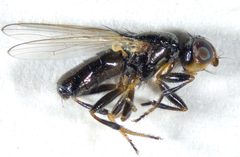
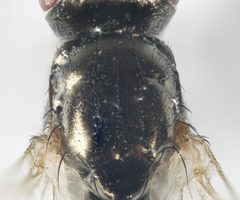
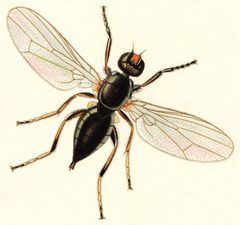
are small, slender flies approximately 4-6 mm in length with long legs adapted for running. They can be distinguished from similar Diptera by their association with dry, protein-rich substrates rather than moist decay. Mature larvae are creamy-white, legless maggots with a characteristic dark ; they are difficult to distinguish visually from other piophilid larvae without microscopic examination. The is most reliably identified by rearing adults from collected larvae or through examination of male genitalia. It co-occurs with Piophila megastigmata in some regions, with P. casei typically more abundant in spring while P. megastigmata dominates in autumn.
Images
Habitat
Cured meat production and storage environments, particularly dry-cured ham curing rooms and aging facilities; post-production storage facilities for protein-rich foods; carrion and decaying animal remains, especially during later stages of decomposition when tissues become drier; natural environments with decaying organic matter. The shows particular affinity for high-protein, low-moisture substrates.
Distribution
distribution with worldwide occurrence; significant economic concern in Italian ham production sector; established in Europe, North America, and other regions; recorded from the Azores (Faial, Pico, São Jorge, São Miguel, Terceira). First Palaearctic records of congeneric P. megastigmata from central Spain indicate expanding regional diversity within the .
Seasonality
Activity patterns strongly influenced by temperature and substrate availability. In ham curing facilities, five to six per year have been documented. Field show seasonal variation in abundance relative to co-occurring : more abundant in spring compared to autumn when P. megastigmata dominates. Development time varies from 21.5 days at 20°C to 12.2 days at 28°C, with minimum development threshold of 9.91°C.
Diet
Decaying organic matter; high-protein substrates including cured meats (particularly Parma ham PDO), carcasses, and other animal remains. Larvae feed on dry or drying tissues, typically colonizing after initial decomposition stages when blow fly activity declines.
Life Cycle
Females mate approximately 24 hours after and begin oviposition about 10 hours post-mating, laying up to 250 . Eggs hatch quickly; larvae progress through three instars while feeding on substrate. Complete development from oviposition to requires approximately 216-221 accumulated degree days above 9.91°C. Larvae can survive up to 6 months without food and are to temperature extremes from -15°C to 51°C. occurs in dry locations; adult emergence follows.
Behavior
Mature larvae exhibit the distinctive "skipper" escape response: when alarmed, they curl into a U-shape, grasp their with their mouthparts, and release suddenly to propel themselves several inches into the air and away from danger. This facilitates to adjacent food products and makes difficult to detect and control. are active runners, frequently observed moving quickly over substrate surfaces.
Ecological Role
contributing to decomposition of protein-rich organic matter. In natural , participates in carrion , typically colonizing remains after initial wave of blow flies. In anthropogenic environments, functions as a pest causing product spoilage and economic loss. Serves as for pupal including Pachycrepoideus vindemiae and Muscidifurax raptor, which have been investigated for .
Human Relevance
Major pest of cured meat industry causing direct product damage and spoilage; for including Clostridium botulinum; public health risk through myiasis from accidental larval ingestion—larvae can survive passage through gastric juices and establish in human intestine. Forensic importance as for estimating post-mortem interval on human remains, particularly during post-active decay stages. Traditional cultural use in production of casu marzu cheese in Sardinia, Italy, where intentional is considered a delicacy.
Similar Taxa
- Piophila megastigmataCo-occurs with P. casei in central Spain and potentially elsewhere in Europe; P. megastigmata arrives earlier at carcasses and persists longer, with reversed seasonal abundance pattern (more abundant in autumn versus spring for P. casei)
- Prochyliza xanthostomaAnother piophilid with similar carrion association, but distinguished by pronounced in —males have greatly elongated with long used in territorial combat, unlike the more uniform head of P. casei
- Calliphoridae (blow flies)Earlier colonizers of remains that precede P. casei; distinguished by metallic coloration, larger size, and preference for moist tissues rather than dry protein substrates
Sources and further reading
- BugGuide
- GBIF taxonomy match
- iNaturalist taxon
- NCBI Taxonomy
- Time Flies, But How Do Flies Tell Time? Ask Yao Cai | Bug Squad
- When Honey Is Not Honey | Bug Squad
- Bug Eric: Strange Flies on a Fish Carcass
- The Flies and Beetles That Turn Death Into Dinner
- Amateur botanists in Brazil discover a genuflexing plant. Portuguese: Botânicos amadores no Brasil descobrem uma planta que faz genuflexão. | Blog
- Pennies for Parasitoids: Savings Add Up When Rearing Wasps on Alternate Hosts
- Factors affecting the bionomics of Piophila casei (L.)
- Cheese (or Ham) Skipper, Piophila casei (Linnaeus) (Insecta: Diptera: Piophilidae)
- Effect of Temperature on Skipper Fly Piophila casei (Insect: Diptera) Reared on Ham
- The Biology of Pachycrepoideus Dubius Ashmead (Hymenoptera), a Pteromalid Parasite of Piophila Casei Linne
- MICROORGANISMS AS INDUCERS OF OVIPOSITION FOR THE CHEESE SKIPPER, PIOPHILA CASEI (L) DIPTERA
- New piophilid in town: the first Palaearctic record of Piophila megastigmata and its coexistence with Piophila casei in central Spain
- Evaluation of Pachycrepoideus vindemiae and Muscidifurax raptor (Hymenoptera: Pteromalidae) as biological control agents of Piophila casei (Diptera: Piophilidae) in ham production facilities